Saturday, March 31, 2007

Bonkers in Honkers

I told B that we should go sightseeing during the weekdays so that the sights would not be crowded with locals. It's the weekend and I don't think any local was sightseeing. No, they were out shopping like us. Such crowds!

No sightseeing for us during our last full day in Hong Kong. Instead we did the local thing and hit the streets in search of bargains. After a late breakfast of congee (rice porridge), yiew tiao (deep fried dough stick) and a deliciously smooth milk custard (ty the ginger flavour!) we set out.

Our quest started nearby to the hotel at the Jade Market. Which is real, which is fake? Neither of us like jade jewellry much and the nicer statues are expensive. Next was browsing the "factory outlets" at Sham Shui Po. They are all local brands and not very nice.

Apliu Street, also at Sham Shui Po, is sort of a Hong Kong street market version of Tokyo's Akihabara Electric Town. Stalls and shops selling all sort of electronic goods. The nearby Golden Computer Arcade was completely packed with young shoppers and computer shops. I felt a primal male urge to aquire some of the flashing lights and shiny computer cases for myself, but just couldn't find a need. Besides which, Tokyo awaits.

At the top of Sham Shui Po's Dragon shopping centre was an amusement park with a currently non-operational rollercoaster and ice rink. A local boy band was making an appearance at the shopping centre and lots of young girls were gathered around the vantage points.

Next, Mong Kok yet again. Too many choices for cameras, phones and other electronic goods. The streets were packed with people, the atmosphere overwhelming. Shoes, sports clothes, again too many choices, though not always to our taste. The Esprit Salon provided some relief, while B had her eyebrows done I was treated to a complimentary soft-drink and a seat. That's an innovation I would like to see in Australia!

On our way back to our local area we stopped again at a multilevel shopping centre filled with tiny stores selling anime and gaming paraphenalia. A few shops sold photos and posters of young idols. I regressed to childhood and purchased some Star Wars Lego - very cheap - to display in my work area. Why didn't they have Star Wars lego when I was 8 years old? It would have made choosing birthday presents much easier.

At the Temple Street Market I found a stall selling rip-off Star Wars figurines amongst a wide range of other cartoon and movie characters. One bag held a good selection, except that a figurine inside had a white hand printed on his head. Perhaps a member of Count Dooku's mob?

I do sound like a nerd, don't I.

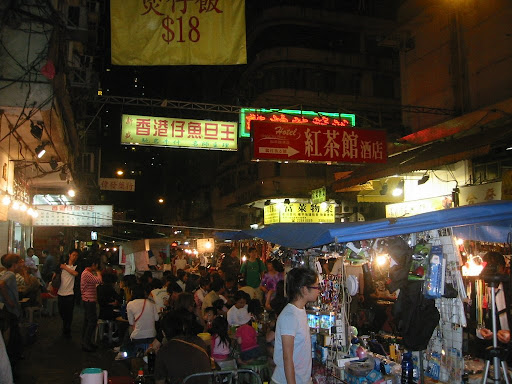
We ate a dinner of radish cake, pippies and stir-fry at an open air restaurant besides the market, helping some British tourists, here for the Rugby Sevens tournament, to order. [Bugger, just saw John Howard on the TV again. Isn't there any escape???]. The most amazing thing about today was that we only took two photos, and they were just before we returned to the hotel!

We've enjoyed staying in Hong Kong, though it does feel like time for a change. There is lots more to see and next time I would like to walk some of the heritage trails in the New Territories and on the islands.

Next stop Tokyo, Japan!

Friday, March 30, 2007

Hanging by a thread

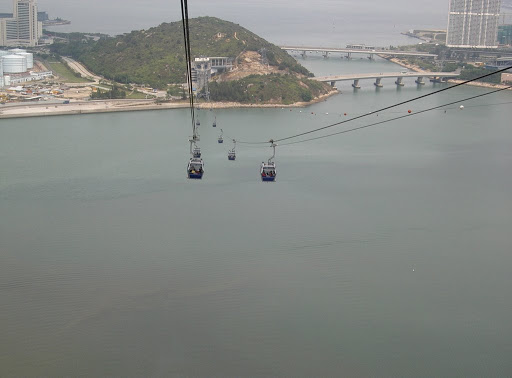
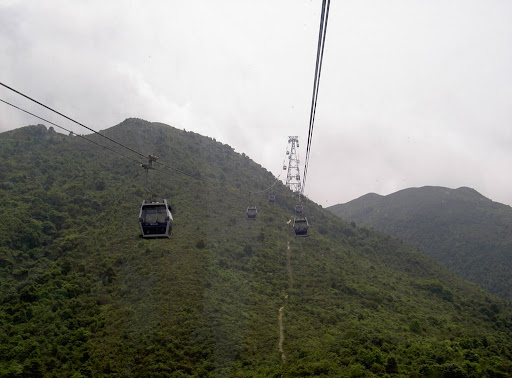
The thread was more of a fat steel cable and there was more than one of them, but it still looked small in comparison to the height above ground. We were travelling on the Ngong Ping 360 cable car up to the Tian Tan Buddha statue looking over Lantau Island. The entire ride takes about 25 minutes.

When you see the cable car in front of you suddenly accelerate down the cable you think you are in for a rollercoaster ride. The truth is much milder. Even the winds closer to the summit didn't trouble the car greatly.

Suspended high above the ground we were treated to spectacular views of the ocean, airport and scrub below. There is a trail that follows much of the cable's route, but more people were seen running down than up. As we neared the summit tombs were seen built into the mountain, good feng shui according to an older Hong Kong resident in our cabin. However, the most awe inspiring view is of the cable system's route as it soars up the mountains. It's not for people scared of heights.

There was low cloud blowing in arround the Buddha statue, mostly obscuring it from view. Tian Tan is the largest outdoor Buddha statue in the world and requires the climbing of 260 steps in order to reach the base. Closer up, the passing mist lent a mystical air to the Buddha, his kindly face looking down upon us.

After another, slightly less spectacular due to the cloud, ride back down the mountain in the cable car we arrived at the CityGate Outlet Centre. B found a couple of things to purchase in the outlet shop, after which we caught the MTR back to our hotel area and wandered until late through the Temple Street and Ladies Markets, eating dinner in a hawker centre.

I should mention lunch (which was also breakfast due to our laziness). We had a second Yum Cha lunch. Again there were no carts and instead we had to order from a menu. Also again was that the flavours didn't seem as good as in most Sydney yum cha restaurants and we were distinctly disappointed.

Last full day in Hong Kong tomorrow. It's been wonderful to stay in a city that is so easy to traverse by public transport and foot. Not certain what we will do tomorrow, but I'm sure we'll have fun.

Thursday, March 29, 2007

All manner of transport

During our time on this trip we have caught all manner of transport, from a trishaw in Beijing to the Maglev in Shanghai. We've been on a hydrofoil on the Yangtze and a couple of sleeper trains across China. And many flights with more to come.

Today was special for the number of different modes of transport we caught in a single day, the day that we left China proper and returned to Hong Kong.

1. Taxi

The taxi drivers wanted RMB100 for the trip from the hotel to Guilin's airport and refused to use the meter. We knew from experience that this was a blatant rip-off. The concierge haggled down to RMB80 and we took it, with time running out. It's a pity to have to suffer cheating on your final day in a country. We met many honest, decent Chinese people, but also quite a few out to rip us off.

2. Aircraft

A China Southern flight took us from Guilin to Shenzhen. Though pretty smooth, the seat pitch was the narrowest of the Chinese carriers and we were each only given a small bottle of water and face wipe. Perhaps this was due to the shortness of the flight - only 50 minutes. Unfortunately, the skies over Guilin were overcast and smoggy so we missed out on the spectacular views from the incoming flight.

3. Minibus

Our original intention was to do some shopping around the land border crossing area into Hong Kong, but when presented with the option of going directly to Hong Kong from the airport decided to take that easier option. We were packed into a minibus for the short ride to Shenzhen's ferry terminal.

4. Catamaran

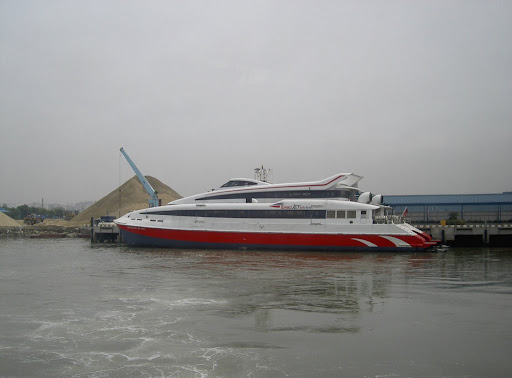
The TurboJET to Hong Kong was a comfortable, modern and fast catamaran that raced us through the placid Pearl Delta to Kowloon. We passed tiny, dingy fishing vessels, small container boats with their own cranes, bigger ships and even a drilling rig. The closer we approached Hong Kong, the more the pollution appeared to subside.

5. Walking

We lugged our two heavy backpacks and one day pack from the ferry terminal to Tsim Sha Tsui. They had definitely increased in weight since the start of our journey. The air in Hong Kong was warm and humid, fresher too compared with mainland China.

6. Mass Transit Railway (MTR)

Tsim Sha Tsui to Yau Ma Tei is only two stations by the underground, but any decrease in walking time was appreciated. The Octopus stored value cards make it so easy.

A quick walk to our hotel, the Dorsett Seaview, same as before, then out again for a lunch of noodles and wonton. Then back to the MTR for a ride to Central on Hong Kong Island.

There we purchased some dried scallops for B's mother and wandered around Hollywood Street, admiring antiques and jade far out of our price range.

7. Escalator

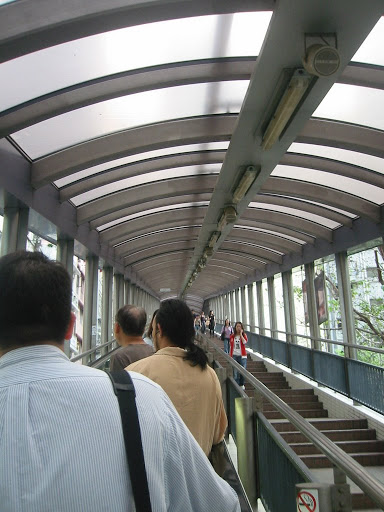
The longest pedestrian escalator in the world is actually a series of smaller escalators with breaks allowing people to join and depart on the ride up to the "Mid-levels". It went on and on and on, but was pretty interesting for the views of the shops and residential towers alongside.

8. Walking again

From the top of the escalator at conduit road we walked East and downhill through part of the botanical and zoological gardens. You could tell that it was a very expensive area, green and pleasant with quite a few expatriates.

9. Cable tram

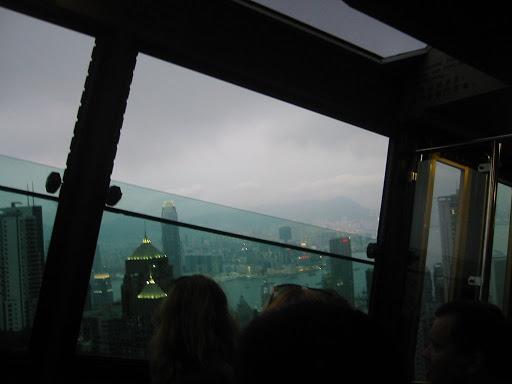
The cable drawn tram ride to the Peak is quite an adventure, rising very steeply at 27 degrees at some points. How anyone can ride standing I don't know. The evening views from the Peak Lookout Tower looking out over Hong Kong Island's cityscape were spectacular, but cloud was just starting to obscure them from the top. It was as if a smoke machine was blown over the top of the tower, the lower levels were beneath the cloud.

The ride down again was even scarier, with all passengers seated backwards. B felt sick afterwards.

10. MTR again

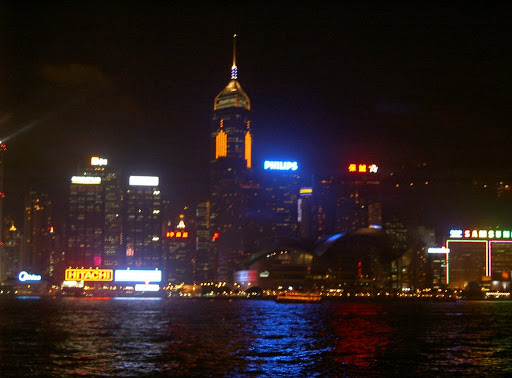
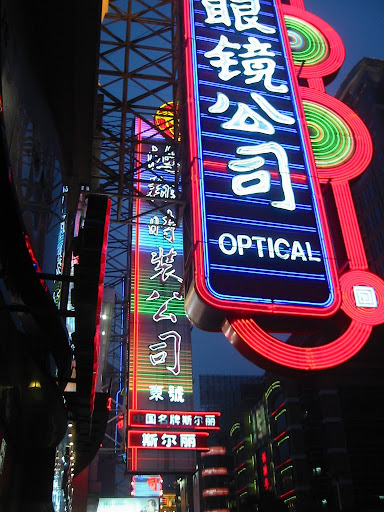
A quick metro ride between Central and Tsim Sha Tsui got us there in time to watch the city skyline lightshow from the Promenade. Green laser beams and white spotlights shot out from the tops of the buildings many of which had colourful light displays on their structures.

It was quite as spectacular as I had hoped, but still quite beautiful.

11. Walking yet again

We walked back along Nathan Road towards our hotel. We chose to return here for the surrounding night markets and local restaurants. Tonight we decided to have a change from Chinese food and ended up in a restaurant where the food was prepared and served factory style. Edible, but not great.

It is a relief to be back in Hong Kong after spending two weeks in mainland China. Don't get me wrong, there were plenty of wonderful sights we saw and great people we met in China. There were also many negatives. It's a tiring place to travel in and I think we just need some time now to relax in a modern locations where we can catch public transport to the sights and not need to rely on others to drive us around and to speak the language for us. I'm pretty certain that we will return to China again one day, but not for a little while at least.

Tomorrow we may add to our tally of transportation types with a cable car ride up to the Po Lin Monastery on Lantau Island.

Pollution

We have experienced every type of pollution during our time in China. Air pollution so bad we can barely speak our throats are so irritated. The water we drink is always boiled or bottled. And as for visual pollution, well the list of ugliness is endless here.

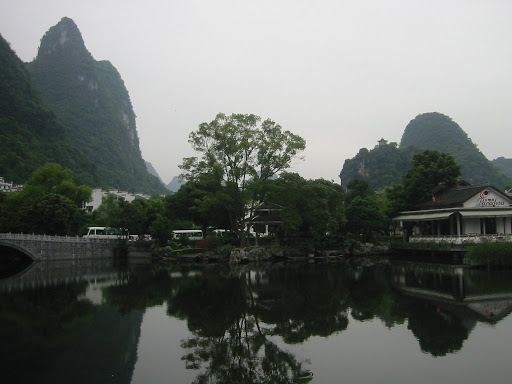
Guilin's air has been the cleanest of our time in China, the water is still dodgy, but the city is actually relatively attractive visually, with the karsts, parks and waterways. Our problem has been noise pollution.

Our first night here was disturbed when a group of Cantonese speakers arrived on our floor. They left their doors open and the old women played mahjong, shrieking at maximum volume late into the night. I shut the door on one group and asked them to be quiet, but they just ignored me.

That's the typical Chinese culture for you. It's so competitive that everyone looks after themselves and ignores everyone else's needs. Want a ticket? Ignore the queue and push in while the clerk is serving someone else. Driving a car? It's up to the crossing pedestrians to get out of the way. Or just take up the entire lane in your slow vehicle. And everyone likes your voice, of course they do, because you are the most important person in the world and everyone should listen to what you say.

Unfortunately, I have increasingly viewed this kind of behaviour in Sydney. Especially amongst iPod users on trains.

We went from a room with a fantastic view of the karsts to one with poor views. And no internet access. I am pissed off!

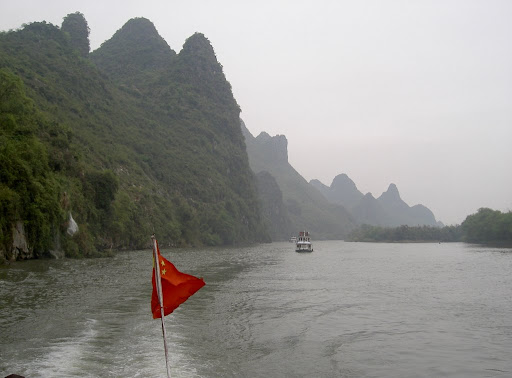
The noise pollution didn't end when we left the hotel this morning for our cruise along the Li River to Yangshuo. Sitting at our table on the boat were older Americans from the Midwest. Of course, they had to constantly verbalise. Talk, talk, talk, talk. They seemed nice enough, but the gorgeous scenery outside lent itself to quiet contemplation, not self-involved conversation. Thankfully it was a bit quieter above deck.

The taxi drivers in Guilin have been quite annoying, demanding set fees and even petrol money at the end over a metered fare. They wanted to charge us RMB100 for the ride to Zhujiang Pier. By the meter it was RMB68.40, a significant saving. The hotel concierge staff can be quite helpful in this regard.

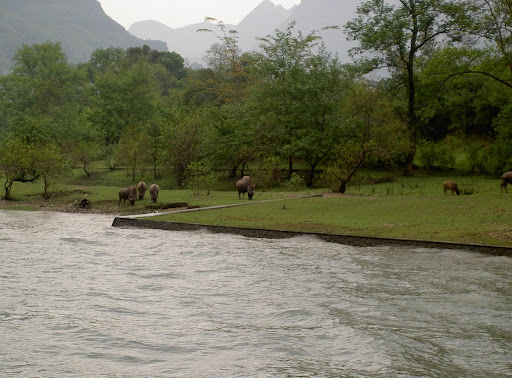
The ride out to the pier was very interesting, passing rice paddies, stone carving villages, buffaloes and a huge pig standing in the road.

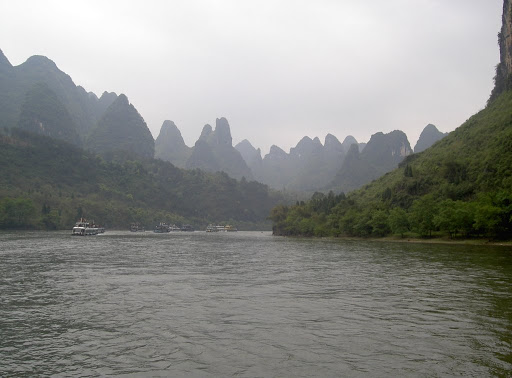
A great parade of boats left the docks for the river cruise. The karst scenery was quite otherworldly. I expected to see dinosaurs emerge from the trees at any moment. The karsts are limestone, the remnants of ancient shellfish, arround which the stone has eroded away, dissolved by the carbonic acid in water and due to vegetation. Interestingly, this is one process by which carbon dioxide in naturally removed from the atmosphere.

We passed bamboo rafts, caves high up the side of the mountains and stalactites growing from above the riverbanks where run-off has dripped down. Buffaloes, ducks and geese wallowed in the shallows, the possessions of the riverside village occupants.

The cruise ticket included a buffet lunch, mainly Chinese food, though the Americans were delighted with the french fries and “Twinkies” (whatever they are). We enjoyed the sweet kumquats, miniature citrus fruit, so much we purchased a bag from a streetside vendor later on.

After all the hype Yangshuo was a disappointment. Lots of tourist good shops, lots of the same old shops existing anywhere in China. At least the shopkeepers were less aggressive than elsewhere, probably understanding westerners' aversion to such tactics.

We visited KFC for its toilets (clean, but squat only for men) and ate some yummy peach egg tarts – different to Australia! Many attractive karsts dot the town, but we had had our fill and had no energy to climb (I am still busy sniffling away). So we caught a bus back to Guilin.

The bus ride was slow, bumpy and dusty. The noise pollution continued with the driver's frequent sounding of the horn. Despite this, we still fell asleep for some of the ride.

Dinner was in the hotel restaurant. Unremarkable, except that a couple of musicians were playing the lute and Chinese harp, the guzheng, both beautiful instruments.

Tomorrow we leave for Shenzhen and Hong Kong. I'll be glad to be leaving China proper and indeed I'm looking forward now to Japan, a country of manners and cleanliness. China has been a very interesting experience, but it is wearying and it's time now for a holiday.

Wednesday, March 28, 2007

No update

Network doesn't work in our new room so no update tonight. Noisy Cantonese drove us out. Will take revenge tomorrow in HK.

Tuesday, March 27, 2007

Floating on air

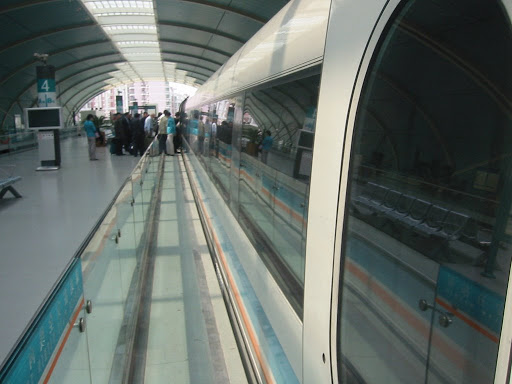
Is 431km/h the fastest we have ever travelled on land? I'm not certain it counts as we were actually floating above the ground. Today we caught the Maglev, the magnetic levitation train, between Shanghai and Pudong Airport.

I think we finally worked out Shanghai metro's ticketing system. You can't reuse your ticket when interchanging between Line 3 and Line 1 at Shanghai station. But you can when interchanging between Lines 3, 4 and 2! It was a roundabout way to get to the airport and, at RMB50 per person for the Maglev ride, perhaps not the cheapest. But it was a fun, if shortlived, pleasure.

The amazing thing about the Maglev is how smooth and unnoticable the acceleration is. I've caught both the Shinkansen and TGV and neither were as smooth as the Maglev. Wish we could travel to work on one!

The flight between Shanghai and Guilin was the best yet of this trip. Shanghai Airlines seemed okay, though sometimes their English announcements were garbled and the coconut cream roll as a bit stale. The KitKat was good, though. I had forgotten how good chocolate tastes.

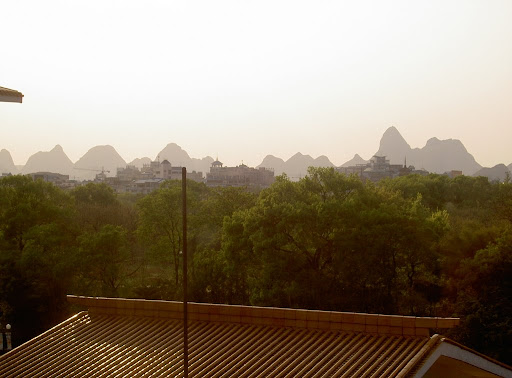
I thoroughly recommend a daytime flight to Guilin. The approach over the limestone karsts and the shimmering mosaics of the rice paddy fields was spectacular. It was the sunniest weather all trip, though the smog layer was always visible.

Our room at the Guishan Hotel has wonderful views of limestone karsts. The grounds also seem quite pleasant. We walked down to the local shops, purchasing tiny sweet mangos and bananas from the market vendors, ordered meat and tofu skewers with the help of some giggling schoolgirls.

Dinner was delicious guilin rice noodles and fried fish in a sweet and sour style sauce. Guilin seems to be a relaxed (except for the traffic) small city and a pleasant place for an evening walk.

Off on a Li River cruise to Yanghshuo tomorrow.

Monday, March 26, 2007

Route Canal

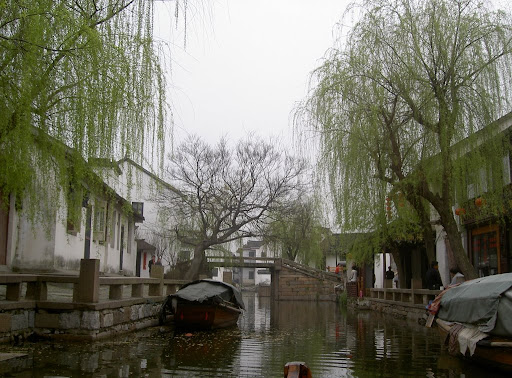
Canals evoke the image of romantic travel in me. We passed through part of China's extensive canal network during our approach to Shanghai. It looked very much alive, with barges and low boats carrying raw materials and finished products. Old wooden sampans moored beside decaying buildings or under low bridges illustrated the long history of China's canals, dating back a thousand years or more. So I was looking forward to visiting Zhouzhang, one of the area's famous Water Towns and threaded by canals.

The town itself is quite attractive, with narrow pedestrian (and bicycle) only streets of local brick, but the effect was ruined by the aggressive shopkeepers occupying almost every building. They all sold the same thing, silk crafts, wood carvings, paintings, pig trotters. Worse were the restaurant touts, each advertising the same meal, each trying to get you inside.

There were some pleasant spots, the Quanfu temple with its outlook on to the lake, the lute playing at the Ancient Opera Stage (before a performance of Chinese opera drove us off) and, best of al, Zhang's House, a maze of rooms and small garden scenes.

We took a gondola ride through the canals, which was very pleasant, until the driver started singing badly and demanding money for it.

Our pogo-stick bus ride back to Shanghai was interrupted by a detour to a silk shop where we were treated to a fashion show complete with catwalk an coloured spot lights. Hilarious really. None of the foreign tourists bought anything, but I think the Chinese enjoyed it.

Maybe the smallpox button in the hotel room didn't give me that virtually extinct disease, but I have had a very sore throat all day. Not surprising with all the pollution and Chinese habit of sharing phlegm. So I wasn't in the happiest of moods today and the touts didn't help.

I found the canals we passed during the bus ride back to Shanghai far more evocative. I think that Suzhou may have been a better choice to see these, along with the gardens. Next time maybe...

Sunday, March 25, 2007

The Bizarre and the Bazaar

It's much less effort to walk ten kilometres of the Great Wall than to spend an hour standing around clothes shopping. Oh my sore feet! At least the pain in the hip [pocket] was only mild, this being China.

We were both feeling much better about China after a good rest and late morning! The hotel is very clean and the rooms appear fresh, but I do have my concerns. There is a switch on the light control board labelled Smallpox. It turns on the downlights, but what else might it do?

Even if the hotel could be a site for biological terrorism, it is convenient. We booked our flight on the 27th to Guilin in the Shanghai Airlines office in the lobby. The flight was picked to depart from Pudong Airport, giving us an excuse to catch the Maglev.

A branch of the Shanghai Sightseeing Bus group is also just over the road from us, so we booked a day trip to Zhouzhang tomorrow. I also wanted to see the gardens of Suzhou, but combining this (an easy train ride) with a trip to a canal town looks troublesome, so it's on the list for a future visit.

After the booking we engaged in that most exciting of activities, crossing a Shanghai street. Still alive, we bought tickets on the light rail back to People's Square. We just don't get how the single trip tickets work. We ask to go to People's Square, but have to exits to change to the subway at Shanghai Station. At that point the tickets are eaten by the gate. We then need to queue and buy more tickets for the subway. I'm certain that we are doing something wrong, but what?

Watching the locals board the empty subway carriages at Shanghai Station's subway is hilarious. They prime themselves when the train pulls up, then sprint (well, they would sprint if they had room to do so) and push inside as soon as the doors open, in order to grab the precious plastic seats. Anything to "win" against other people I suspect.

From People's Square we walked south, then east, our objective being the Shanghai Old Street and Yuyuan Gardens. We turned off into one narrow, busy street with a number of "Islamic restaurants". A beggar dragging a monkey tied by the wrist asked for money. The poor monkey looked unhealthy with raw red patches. It was an awful sight.

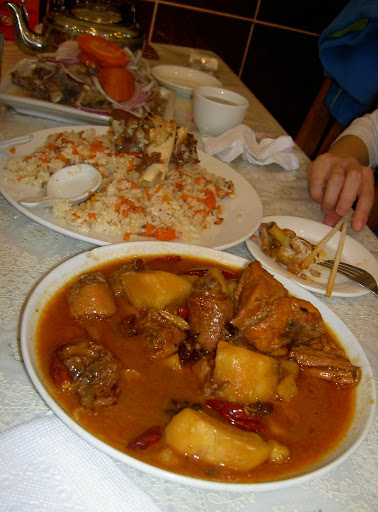
On impulse we had lunch at the Xin Jiang Yi Li Can Ting Islamic restaurant and asked the waitress to recommend some dishes. We thought we had ordered too much, but ended up just eating too much. Delicious roast mutton melting off the bone, served with red onion and carrot. Chicken in a red stew, like a curry, strongly flavoured. A rice pilaf with carrots and stewed in mutton broth, so full of flavour. The second best meal in China after the Leshan river fish.

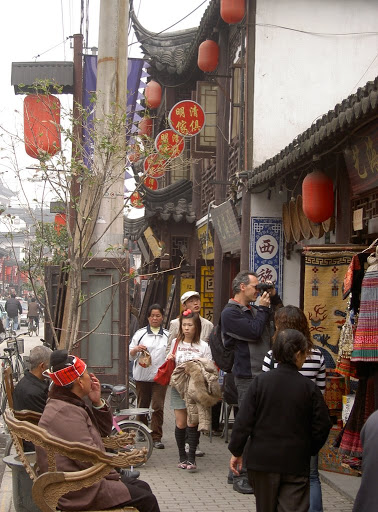
Shanghai Old Street is a tourist trap lined with souvenier stalls, but we couldn't resist purchasing some momentoes, prices haggled far down. Noisy, busy, but still quite fun.

Depsite the many tour groups the Yuyuan Gardens provided a respite from the noise outside. I love the way there are so many hidden paths to follow in a Chinese garden, the framed views, the water, stone and bamboo. It was wonderful to sit down and relax.

Outside the Yuyuan Gardens we braved the crowds once more, but there was no way we would fit on the famous zigzag bridge to the teahouse - it was packed. Instead we walked onwards to the Bund and then down into the sightseeing tunnel.

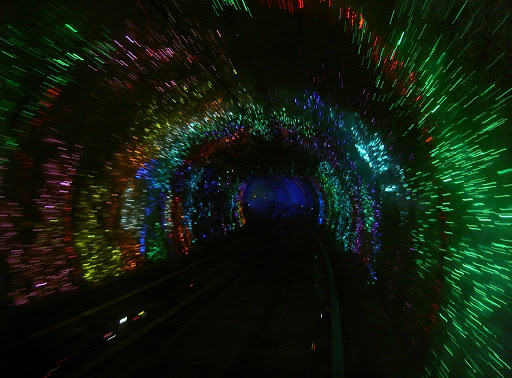
The tunnel underneath the Huangpu River is super tacky, but fun. A cable car on rails takes you through a light show complete with lasers and those inflatable figures that flap around outside of car yards.

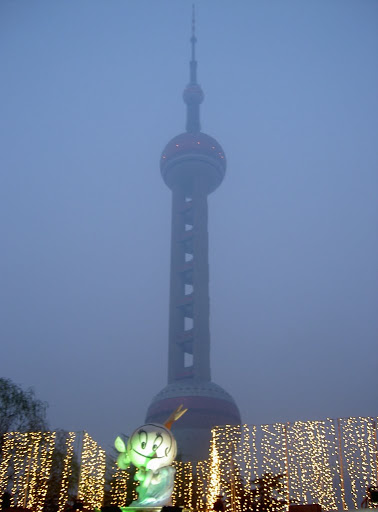
We emerged near the Oriental Pearl Tower, the symbol of modern Shanghai. B was wondering when she would get a chance to go shopping. I told her that we would catch a subway under the river to Huaihai Lu, so we walked in the direction of the station. Then, opposite the Pearl Tower entrance she saw a magical sign: Sephora. Then Zara. Her two most favouritest shops in all of Europe.

My feet were ready to collapse by the time we had dinner. I didn't really enjoy the food at the Yunnan restaurant, but the lime juice and B's apple pearl drink were delicious. The shops were shutting by the time we finished, so it was back to the hotel, past the amazingly tall architecture of Pudong.

Canals await tomorrow!

Saturday, March 24, 2007

Shanghaied!

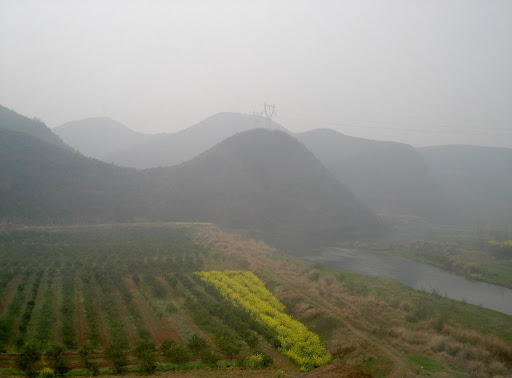
Something just snapped in me yesterday as we travelled through the yellow rapeseed fields from Yichang to Nanjing. Maybe it was the smoking, spitting, shouting, shoving migrant workers at Yichang railway stations. Or the polluted air, the disturbing sameness to the cities and the farms. Or frustration at my inability to speak the language or to freely travel around without relying on others. Even the food. Or all of the above. Suddenly my tolerance of China disappeared. I found myself wishing I were somewhere else.

I certainly did not want to be on that train. As we walked up the steep steps to Yichang railway station we were surrounded by peasant workers, belongings wrapped in makeshift bags of sheets. The Chinese push in whenever possible, don't give way. I've learned just to barge in and not care if my backpack takes bystanders out.

Not knowing where to go we passed our bags through the x-ray machine and entered the general waiting room. It was a scary experience, surrounded by crowds of people whose appearance was that of those shouting, shrieking drug addicts you sometimes see on the streets of Sydney. But I guess that this is often a new experience for them too and most are probably very nice people.

Backing out, the security guard pointed us in the direction of the "soft class" waiting room. A helpful local had to point out ts entrance behind locked doors. The soft class attendants ushered us straight to the train, not even bothering to check our luggage.

The soft sleeper cabin was a lot less comfortable than the cabin we travelled in from Hong Kong to Bejing. Four narrow, hard beds arranged in two bunks. Dodgy looking linen. The carriage toilet a dirty squat.

The old couple we shared the compartment we very nice and kept offering pomelos, apples and sunflower seeds. Thankfully they didn't like smoking either, for the overcrowded train contained plenty of smokers in the corridor in defiance of the no smoking sign. However the lady insisted of leaving the door open most of the time. This may have been a good thing as she kept coughing through the night (and no hand to cover the mouth, of course). Probably going to get tuberculosis, SARS or fish flu from her now.

The train stunk of urine and cigarette smoke. It was NOT comfortable whatever the Lonely Planet might say. We couldn't face another night of this, were already worn out from many late nights and early mornings, feeling a bit unwell.

We decided that we were willing to sacrifice some sights for more "stop" time to rest and recuperate. So I rang the wonderful Zhou Yan at CITS on the mobile and cancelled our itinerary post Nanjing, moving forward some nights in Shanghai.Thanks to the wonders of modern mobile technology (2.5G here) I was even able to email the instructions and receive a reply to my mobile phone.

Arriving in Nanjing at about 9:30am we quickly booked an onwards midday ticket to Shanghai (easy!), then spent the next hour in McDonalds near the huge train station. We did try a dumpling place first but it was full and we couldn't order.

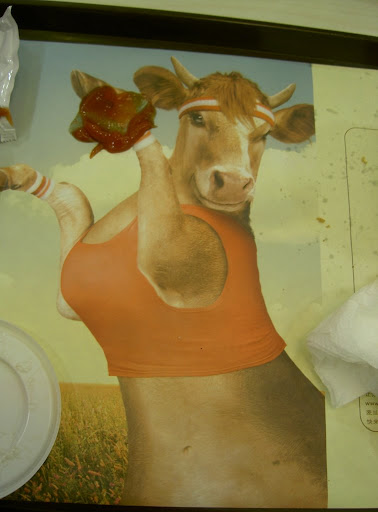
The young lady who served us might have spoken English, but their toilet belied the McDonald's legend. It was a squat and it was dirty, with an overflowing rubbish bin of shit covered toilet paper. From the tray cover I'm also concerned about the source of their beef. The cow looks mad and on hormones.

The extensive canal system was visible after Nanjing, which barges chugging up the waters or decrepit boats just sitting there doing nothing. I would love to take a cruise up the Great Canal, just to observe life on either side.


It is good to be in Shanghai. This three star hotel might be a bit far away from the centre of town, but it's got a light rail stop, plenty of shops and a park nearby. Catching a proper modern metro again was also a good feeling, despite the number of interchanges.

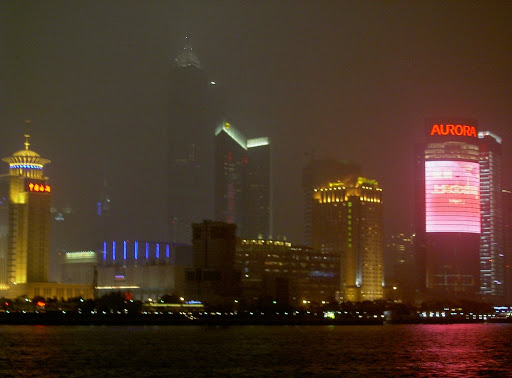
We stopped at Renmin Square and walked along Nanjing Road East until we hit the Bund. From the riverside you can see ultramodern Pudong with its famout Pearl Tower and another, much lower, skyscraper showing video on the side of its walls.

I don't want to give the impression that the Chinese are an awful people or that China is a boring place. It's not and we have met many wonderful Chinese who have brought a smile to our faces with their friendliness and helpfulness.

I think we just need some time to rest and get used to the cultural differences again. I'm certainly exhausted after that train ride and I'm certain tomorrow will find us enjoying China once more.

Thursday, March 22, 2007

Three Gorges

"I haven't had enough sleep!" screamed my body as the alarm clock rang. No choice! We were meeting our guide Shirley down at the hotel lobby at 6am for our tour of the Three Gorges after only 3 hours sleep.

It was misty, or smoggy, as usual as we drove out in our van on the hour long trip to the docks. Faint silhouettes of mountains suggested beautiful scenery, although our eyes kept shutting, stealing more sleep.

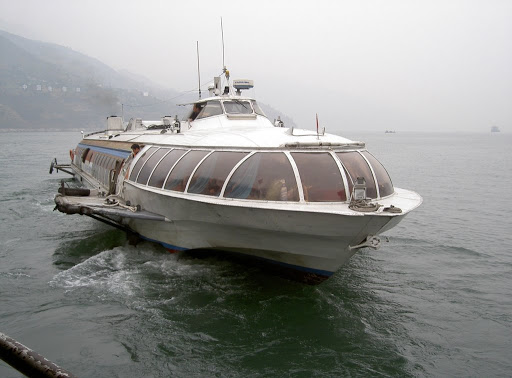
A steep staircase flanked by two huge funiculars greeted us at the docks. We had to clamber over docked river cruisers in order to reach our sleek hydrofoil. We found three seats near the front as the boat filled up with workers in transit between the river towns. This was a working transport boat, not a tourist cruiser.

Through Xiling Gorge we passed hills yellow with rapeseed flowers or boxy new concrete homes clinging to the steep edges of the valley. The hydrofoil sped past flat, narrow ships transporting all manner of goods, from phosophorus to trucks, along the river.

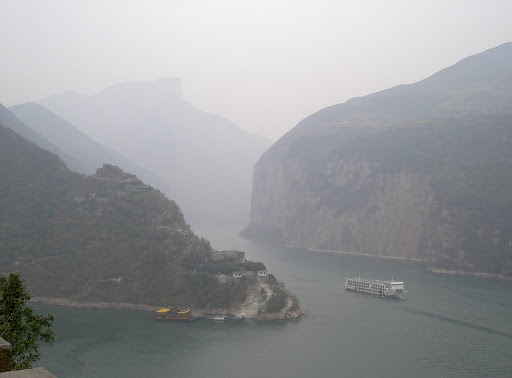
Long Wu Gorge was the most spectacular with steep geologically folded cliffs and tall forested peaks, each with a name.

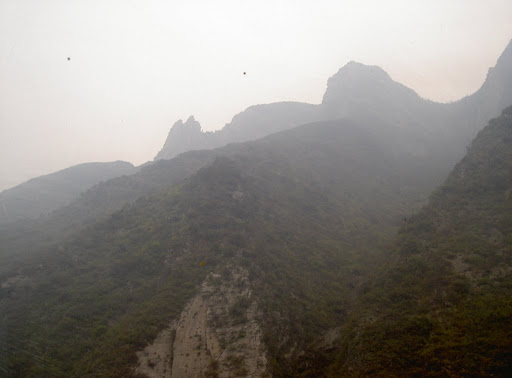
The last of the Three Gorges was Qutang. While the scenery adjacent to the river was not as impressive as Wu Gorge, the dramatic mountain range surrounding it loomed large behind the smoggy air.

Throughout the journey we could see a pale strip a few metres high running along the waterline. The water level in the dam has actually dropped from summer, as the water supply is locked up as ice in the mountains over winter. The water colour is a clean blue green now, but once the ice melts it will turn muddy brown again. Signs show that ultimately the water will rise about 15 metres higher than the current level, submerging more of the scenery.

After some negotiation between Shirley and the boat crew we were dropped off at the base of Fengjie. A yet uncompleted bridge loomed tall over the small fishing docks. Shrimps covered the roofs of the small fishing vessels, drying in the sun. We ate carp straight from the boat and noodles under a tarpaulin, the fishermen noisily playing mahjong at another table.

More steep stairs led us up the hill to Fengjie, White Emporer Temple. A noble had a vision of white mist rising from a well in the form of a dragon. As a dragon is the symbol of an emperor he went about making himself king of the region, with the help of a brilliant strategist.

The temple is a quiet place suited for contemplation, with ponds, pavilions, blossoming trees and some beautiful views over Qutang Gorge. The complex is surrounded by peeling red walls and fading but colourful reliefs and contains black steles of poetry inspired by the beauty of the gorges.

After walking back down to the fishing docks we discovered that the boat would not arrive for a while. It was an opportunity to chat with Shirley about life in China. We came away thankful for living in a first world country, how it gives us some many more opportunities. There are so many restrictions on realising your full potential in China, so much competition for resources, the familial duties which bind your choices. Even the disparity of wages means that it is difficult for young Chinese to travel overseas, something which they would benefit a lot from, giving them an opportunity to discover alternatives.

We were forced to find seats in the dirty rear of the boat for the ride home. Smoke from the engines frequently entered the cabin and the windows were cracked and patched. There was not much opportunity to view the scenery and all of us slept for a while, exhausted by the early start.

On our ride back from the docks to Yichang we passed the giant dam locks, were told of an even bigger "ship elevator" to life tourist ships all the way from the base of the dam to the top in one movement.

The expressway back to Yichang took us past some magnificent scenery, looking down to the Yangtze River with a backdrop of mountains. This was where Mao had swum across the river, proclaiming that the dam should be built, though the process started long after he died. From one view the mountain tops appear like his facing looking upwards, so this area is considered auspicious for the dam.

Shirley pointed out to us that our hotel was just across from the public square, recommending that we go to the top floor of the only department store for a food court. We followed her instructions and indeed had a delicious dinner. We had very pleasant wander back to the hotel past groups of people dancing, or just walking around relaxing in the colourfully lit square. A "magic fountain" reflected the many lights at its base as alternate sections sprayed water into the air.

Prior to Yichang we were doubtful about using the services of a local guide, thinking that we would just get a prepackaged spiel and run between the sights. But we greatly enjoyed talking to Shirley and she really went out of her way to make our stay here very pleasant. Thank you!

This will probably be the last post here until we reach Shanghai. In a few hours we will be on the overnight train to Nanjing for a day, then another overnight train to Huangshan. A night up the summit of Huangshan, then an overnight train to Shanghai. It promises to be very tiring!

Wednesday, March 21, 2007

The effects of globalisation on the Chinese culinary experience

We have been naughty. Very, very naughty. In our defence I can state that we were only following the instructions given to us by my colleague P2. But really, there is no excuse for our behaviour in a province with such reputation for its cuisine. For today we ate at McDonalds.

We made a mistake staying two nights and three days in Chengdu. We could easily have seen the sights we wanted to see in two days and spent more time in Shanghai or Hong Kong, but that's what you get for rushed planning in a travel agent's office.

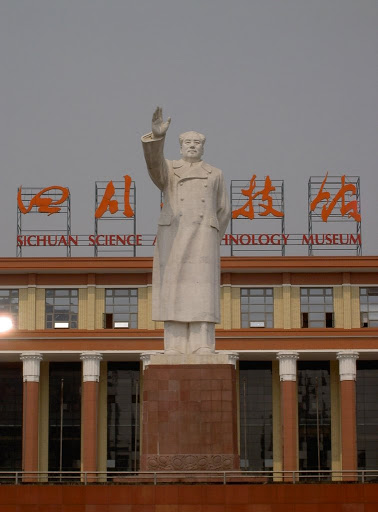
The hotel finally kicked us out of our room after midday. We wandered through the centre of the city aimlessly, through posh department stalls to markets in narrow laneways. At Tianfu Square a big statue of Mao stood, right hand raised, in front of the Sichuan Museum of Science and Technology.

We were tired of walking and had no small change for lunch at the street stalls. So, heads hung in shame, we climbed the stairs up to the McDonalds overlooking Tianfu Square and the Mao Statue. There's a message there somewhere, though I'm not certain if I know what it is.

Using the picture card at the counter for language loosers like us, we ordered a medium spicy chicken sandwich (chicken breast roll) meal, a pineapple sundae and a sweet taro pie. The chicken was real chicken, the french fries not so good, the Coke Coke. But the pineapple sundae was really nice, must be the synthetic pineapple flavour. The taro pie, like an McDonalds apple pie on the outside, had purple and white chunks of taro, a root vegetable, on the inside. Very good!

So we went back and ordered chicken nuggets and a pineapple pie... It was good.

We wandered back to the hotel, past the GiGi bakery where a pastry chef was doodling around with the cream, making what looked to be an animal. She smiled at us, not having any idea what she was making either. We sat around in the hotel lobby for a while, bored.

Later we walked to a nearby Sichuan fast food restaurant and order a meat (or was it tripe?) bun and local style fried rice. Most of it remained on the table uneaten. It was too hot, but also the flavour was not to either of our liking. The only really good Sichuan food we ate was at the Fishermen Village at Leshan. Sadly, the McDonalds and the Pizza Hut meals were enjoyed far more than the local fare.

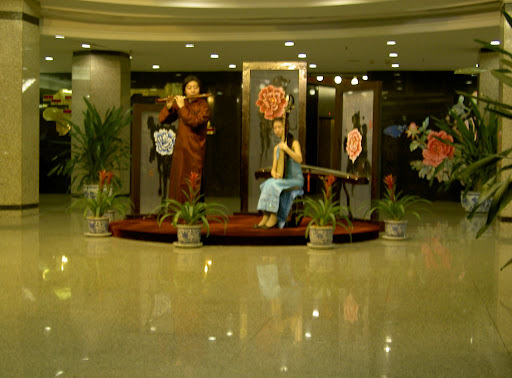
We would have left Chengdu with disappointing memories for the day, but as we sat there in the lobby a couple of musicians began playing a Chinese flute and lute (pipa?). The male flautist provided strong melodies while the female lute player's finger literally danced over the strings. It was both beautiful to listen to and to watch.

For RMB10 each we caught a bus from next to the hotel to Chengdu airport. I was amusing to watch the taxi touts chase us as the bellboy wheeled our luggage out the bus. The looks on their faces as we caught the bus said it all.

Chengdu airport is pretty nice. We bought a few lo quats from the fruit stall prior to security. The helpful staff even let us try the fruit first. Sweet, a little like an apricot.

We were bused to the Sichuan Airlines ERJ-145 sitting far out on the tarmac. It was a small jet, three abreast and the service was basic, with water, peanuts (The Lingdom of Foods) and sour dates. But the flight was pretty smooth and there were good views of Chengdu as we took off.

Yichang airport shut down straight after we exited the airport. Ignoring the taxi touts we caught a minibus to the city for RMB20 each. The driver said he could take us to our hotel, the Xixzhou (and how do you pronounce that?). After a long and bumpy ride past industrial wastelands and into a city preparing for sleep we were told by another passenger, a young lady, that we should get off and catch a taxi for a short ride to the hotel.

The taxis were trailing right behind us, so it was easy to catch one, the cost was, just as the lady said, RMB5. The hotel staff don't seem to speak English, but we were met in the lobby by "Shirley", our very chirpy young CITS tour guide for tomorrow. I have to say that I'm highly impressed by the CITS service we've received thus far, despite the impression given by some travel references. Should be a fun day cruising up the Yangtze tomorrow.

Tuesday, March 20, 2007

Panda Slam!

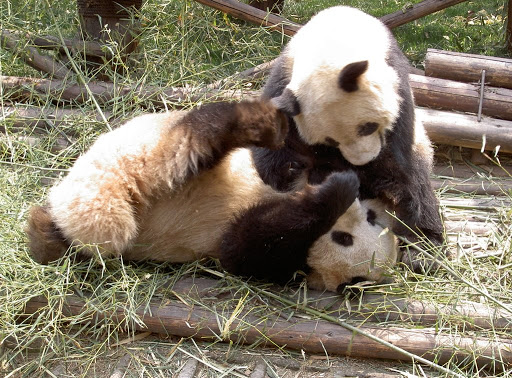
In one corner is Panda 1, The Bamboo Muncher. In the other is Panda 2, Backwards Walker. The battle begins with Walker waddling backwards into Muncher. They tussle in the bamboo, Walker on top, no Muncher, no Walker, Muncher. They chase around the enclosure. One climbs a tree, the other pulls him down. Back on the bamboo, the fights nears the moat. In one big movement Muncher throws Walker down tumbling into the moat. Muncher is triumphant, rolling his arms around and doing the Panda Dance!

Our first destination today was the Panda Research Centre outside of Chengdu. We got out of the room late, just in time for breakfast in the hotel. The western buffet was not great, but the local food, including noodles, rice, porridge and dumplings was delicious. Nice to have some fresh fruit too. We are both looking forward to trying more tomorrow.

We walked outside of the hotel in search of a taxi to take us to the Panda Centre. A tout tried hard to get us in his taxi. "No meter. Too far! What do you want to pay?" he asks. "$30" I reply. "Costs more" he responds.

Giving up, we return to the hotel to ask what a good price is. They say $50, but will call in a taxi prepared to use the meter.

The driver takes us through run down suburbs in the process of demolition and reconstruction. Here is real Chengdu street life and it is fascinating. When we reach the Panda Centre the meter reads RMB31. So there, you damn touts!

The Panda Research and Breeding Centre is the most professionally operated of the tourist sights we have yet seen in China. The grounds are green with a wide variety of trees and plants, wide paths and excellent signs.

We thought that, at 10:40am, we were too late to see the Pandas feeding and that they would all be asleep. Not so! At the Panda Adult Enclosure Number 14 we see a few pandas chewing on bamboo or pacing around. Then we walk up to the Red Panda Enclosure Number 2 the small racoon-like red pandas are walking around, or grooming themselves. Quite vain, the red panda.
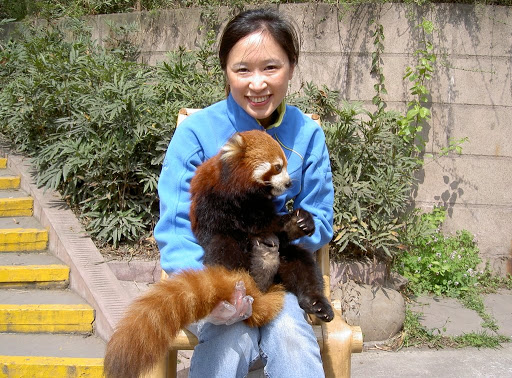
We were given the opportunity to be photographed holding a red panda for RMB50 each. Why not? So we donned the disposable gloves and sat down on the bamboo chair, a red panda placed on our lap. The attendants fed the panda slices of apple in order to attract their attention.

The red panda's tail is long and very bushy. I noticed that, unlike a dog, the nails were transparent and the pink cuticle clearly visible inside. At less than A$10 a pop it was worth it to get up and close with the animals.

No pandas were visible in the Panda nursery, it was probably the wrong time of year. However, the panda kindergarten was buzzing. An attendant was playing with the pandas in their enclosure. While most slept up in the wooden climbing platforms one panda was especially active. He even bit the attendant's leg when he wasn't looking.

Unfortunately, the RMB1000 "donation" to be photographed with a young panda (or RMB400 with a "teenager" panda) was too much for us this time, though at least the money is probably going towards a good cause.

The next enclosure, for teenage pandas, before they become solitary, was where we saw the panda wrestling match. Their antics, like those of the kindergarten pandas, had us entranced for ages. Whatever their real nature, the pandas really are cute to watch.

Also cute were the hordes of young schoolchildren on excursion to the centre. They seemed very curious about me, shouting out "hello" and giggling away. Later, in the onsite Panda Museum, a few wanted to shake my hand or even attack me. Why do kids see me as a punching bag? :)

From the Panda Centre we caught a van to the Wenshu Temple area. The area has been kept in Ye Olde Chinese style with beautiful courtyards filled with craft shops, food stalls and tea houses. But before we entered the courtyard area proper we were tempted outwards by a wonderful smell. The kind of nice smell you usually don't get in China. It was familiar, but what could it be?

A sweet bakery, the counter crowded with waiting customers. We pointed and ordered, not knowing what it was we were getting. Turned out that we had bought incredibly delicious lemon cream puffs, a sweet pastry, cooling minty Chinese dough roles, golden syrup cake and a bag of moreish ginerbread biscuits, also with a mint-cooling aftertaste. We even returned for more at the end of the day, the food was that good.
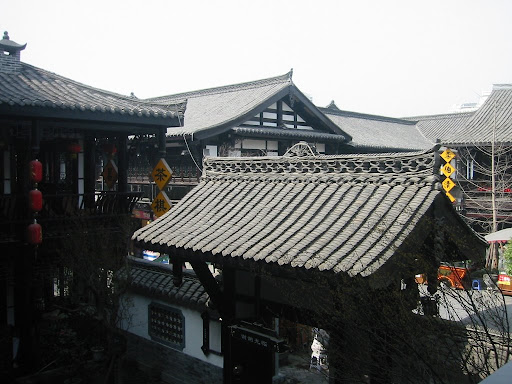
From a little store we ordered "traditional Sichuan buckwheat noodles", squeezed out from the dough right in front of our eyes. I enjoyed the soba-like noodles, while B drank the soup they were cooked in. Besides the noodle stall was an american drawing and selling caricatures. An amusing juxtaposition from Sydney, where it's usually Chinese artists in the market stalls doing the same thing.

The Wenshu Temple and Monastery cost RMB5 each to enter. There was a garden, turtle pond and series of ornate temple buildings. We watched the yellow monks walk into the temple for evening prayers, listed to the drums and chanting as we walked around.
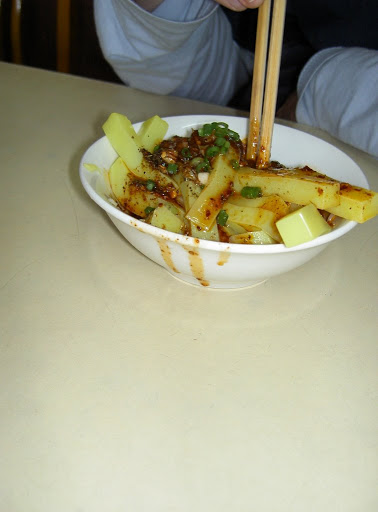
On the way out we stopped by a small shop selling what appeared to thick noodles. Not certain what it really was, except that it was soft, cold in temperature, but extremely hot in spiciness. We could barely eat a couple of spoonfuls before giving up.

Giving up on taxis for the day, we walked back towards the hotel, stopping off at a department store from which the big Mao statue was visible in the distance. As we walked up the lane towards our hotel we passed a dingy but lively area with small shops and restaurants. Thinking that we really should try some more Sichuan cuisine we entered one busy eating house and were directed upstairs. With the help of the phrasebook we ordered a fish (with reduced chilli).

One full table next to us was populated by what looked to be members of the "peasant" class. A couple kept staring at me whenever I wasn't looking their way. It was probably just simple curiosity in this case but I think that some locals have been looking down on B for being seen with a waiguoren (foreigner). Don't blame us if your male preferential policies mean there aren't enough local women!

Our fish and fish head soup came out eventually, much the same as what we ate at Leshan, only much bonier and far less tasty. After the peasants departed we saw a big rat scuttle out for some scraps. It was that kind of place. Hopefully our stomachs will forgive us.

We have one day ahead of us and Chengdu doesn't seem to have many sights within the city proper. Not certain I want to risk a long trip out of town either, they are getting expensive. At least the only thing we need to get up early for tomorrow is breakfast!

Monday, March 19, 2007

In the presence of a giant

As I write this a tradesman is in our bathroom attempting to get a decent water flow in the shower. I was expecting this in China, but the Minshan Hotel is rated four stars according to CITS. I'm not really complaining, for we have had a fantastic day, up there with our walk along the Great Wall.

We (okay, I) woke before 5am in order to get ready for our trip to the airport. Both of us felt nervous as our taxi drove us along darkened back roads on the industrial outskirts of Xian. We could have been dumped there and nobody would see it happen.

But we survived unscathed and reached Xian's domestic terminal unscathed. The airport is quite functional, if unexciting. The toilets, however, stunk of excrement and urine, despite appearing clean. I think that they were of the type where toilet paper is placed in a bin adjacent to the toilet rather than down the drain.

I can't recommend the hot chocolate at the Denise cafe either, but what can you expect?
This time we were flying a China Eastern Airlines Airbus A320. The plane could do with a good wash, but what can you expect from flying above the land of the long grey smog cloud? As we ascended above the cloud layer snow capped mountains poked their summits into the heavens.

It was another rough flight. I wish I was like B and could sleep through the bumpiness. Little LCD screens popped down above the seats to show some promotional piece, sometimes in colour, but mostly in black and white, about Xian, though we were flying in the opposite direction. The hot Chinese meat bun was much appreciated though.

Chengdu airport looks very impressive, their speed at getting the baggage on the belt even more so. We were met by our driver for the day, a much quieter man than Mr Zhou. As we drove out directly towards Leshan, 150 kilometres away from Chengdu, B and I both fell asleep, tired from the early departure and from the late nights and too early mornings before it.

B declared that she no longer liked China due to the amount of spitting. The Chinese don't just let their phlegm drip to the ground. Neither is it a quick hrckt pfft. For them, it is a process of bringing up and flinging out every last drop of mucus inside their bodies, at least for a minute of so. A hhhrrrrrrrrcccccckkkkk, pppppfffffffffttttttt from deep inside their chests. The government is supposed to be cracking down upon it, but spitting seems, by the enthusiasm with which they do it, to be a source of great pleasure for many Chinese.

As we approached Leshan two previously unseen sights emerged: our first Chinese rain and motorcyclists wearing helmets.

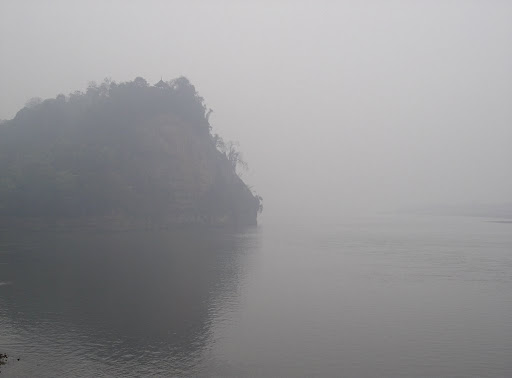
But forget rain, spitting, pollution and anything disgusting or bad about China. A walk around the Big Buddha at Leshan was absolutely beautiful. After we stepped past the gate and started up the trail past the Buddhist grottoes, the dragon and the tiger statues, up into rainforest, bamboo and palm, we were in another world, a magical place.

The Liguyan Buddhist temple was guarded by colourful bodhisavattas, more like Hindu gods or demons. Then we were in a serene environment of monks, candles and incense, soothing music in the background.

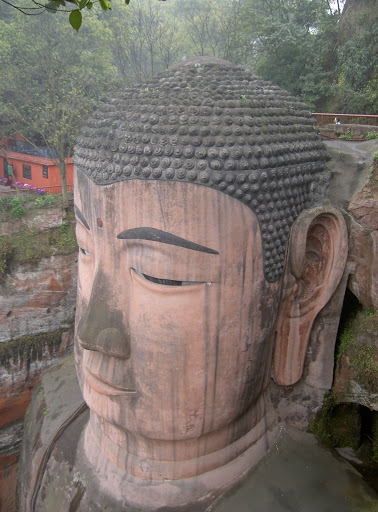
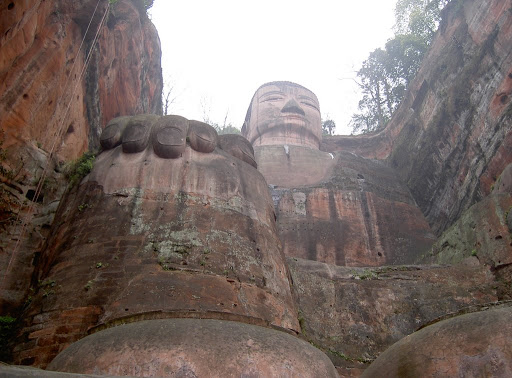
Dafo, the big Buddha statue is 71 metres high, carved out of the red sandstone face of Liguyan Hill to provide protection for travellers along the Min River. The statue of the monk Haitong, the driving force behind Dafo's construction, sits nearby. The story goes he gouged his own eyes out to demonstrate his devotion to the project after a corrupt official threatened to blind him if he didn't get a cut of the funds.

Standing besides Dafo you feel like you are in the presence of a giant. He is a truly incredible creation. We climbed down the steep steps besides the statue, taking in every facet. The more you stare, the more alive he becomes, as if he is about to stand up and walk.

We took the walk around and through the cliffs, taking in the views of the Min River and the valley and stopping off at the pagoda lookouts. We saw the narrow fishing boats and fishermen encampments near the river bank. At the recreated fishermen's village we were accosted by old ladies trying to show us menus. We kept walking.

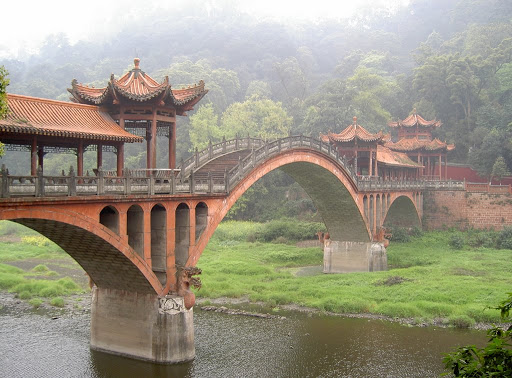
The old style, partly covered Haoshang Bridge provided a great view of the fisherfolk amongst the yellow rapeseed flowers. We crossed, then returned to the Mahao Cave Tombs, hollowed out rectangular caves into which families were buried upon their deaths, with various pottery items enclosed with them, not entirely unlike the Banpo neolithic peoples.

We walked back up to the fishing village, and finally agreed to eat a fish from the buckets. The old lady demonstrated that the prices were by weight, not fixed, took a fish and slammed it into the ground, before taking it inside to prepare it.

We ate an incredibly delicious meal of sichuan fish, fish head soup and rice, sipping hot tea. It was the best meal so far in China and good value at RMB50 for two. Only the bones were left once we were finished.

Trying to backtrack to the Linguyan Temple, we didn't realise that the tickets work in one direction only. But the ticket ladies were kind enough to issue us with new tickets for no charge. We took a different route back, up past the waterfall and wall of calligraphy, a beautiful, peaceful place.

It was time to return to the car, despite the many other sights left unseen. Again we slept for much of the drive back, arriving at the Minshan Hotel in Chengdu. It is a decent hotel, though we have now been shifted to a new room where the shower works. Free internet access too.

We were naughty tonight. After walking into the centre of Chengdu and trying delicious spiced skewered beef we ate dinner at Pizza Hut. Neither of us regretted having a change of diet, with salads and smoothies. Tomorrow, is pandas and proper sichuan food again!

Sunday, March 18, 2007

Ancient smurfs, terracotta warriors

We felt like really little package tourists today, from eating a hot buffet breakfast to following a flag toting guide. Up early to eat bacon and eggs and to meet our guide for the day, a young lady in pink with the English name of Ruby.

Our minibus stopped at two other hotels, further from the local CITS but much more convenient for the guests, to pick up another ten tourists, including an old Finnish gay man and his younger Thai partner and a couple of Swiss and Italians. On the way our coach driver got into a verbal argument with some men from a wedding party over who had the right to block the hotel driveway. We then drove off to the nearest of the day's destinations, the Big Wild Goose Pagoda.

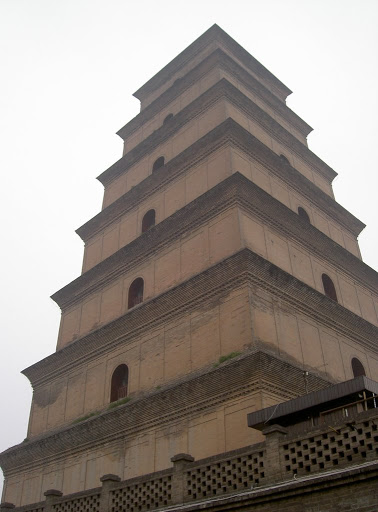
The pagoda was built to house the precious Buddhist artifacts and scrolls brought back from India by the monk Xuanzang. Xuanzang's pilgrimage formed the basis of the story Journey into the West, better known by the Japanese television series Monkey!

While the central 64 metre pagoda is impressive (we were too lazy to climb it), also worth seeing is the colourful jade wall representation of Sakyamuni's (Buddha's) life. The story has obviously undergone some modifications over the years, with Sakyamuni now depicted as having special powers as a baby and a halo through his life - very much like the story of Christ.

The wooden depictions of Xuanzang's journey are also worth a look, though I could not see any monkeys flying around on clouds.

The following destination was the obligatory shopping stop, ostensibly to learn how the warriors were constructed (head and hands moulded separately from the body, which was made on a pottery wheel). Really, it was just a shallow attempt to get us to buy various sized repoductions and furniture.

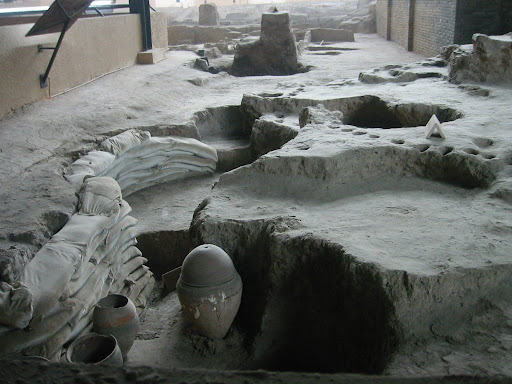
Next stop was the Banpo Ancient Village. This is the site of excavations of a neolithic village from 6000 years ago. The Banpo society was apparently matriarchal and according to our guide there was no central management structure and everyone worked for the common good of the village - conveniently communist methinks.

From the shape of the ground indentations the Banpo people were neolithic smurfs. Not certain about their skin colour being blue, but they did live in mushrooms. Or so their wood and adobe houses appeared.

Excavations show the skeletons of adults, sometimes buried together in communual cemetary grounds. The babies were placed in clay pots kept in the houses of the mothers, who would continue to "look after" their offspring. Descendants were also known to chop off a couple of their digits to be buried with their parents. Don't remember ever seeing the smurfs doing that.

The lunch was also vary much a tourist trap location, though at least B got to eat some rice (short grain - the Cantonese seem to use long grain). The food was okay and at least we didn't go through our normal practice of searching the whole city for food.

Each time the coach set off we napped. After late nights and early mornings we were both exhausted. A couple of good things about the tour was that we were driven around and could relax from planning and thinking.

Finally, we made it to the Terracotta Warriors, braving the hawkers as we made our way up from the carpark to the excavation site. There was a lot of redevelopment going on, with men jackhammering away and women using picks. Posters lined the sides of the path, one stating:

Qin Wind, Qin Smelody, Qin Culture

Maybe they also ate cabbages for lunch.

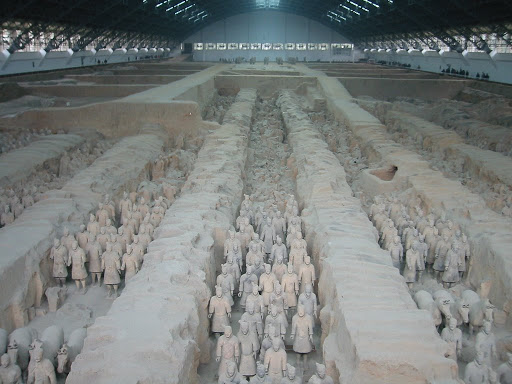
The warriors were as impressive as the hype suggested. There are three excavations. The first pit is in the aircraft hanger like building. This contains the reconstructed warriors in formation, plus others in a partly reconstructed state. Much of the location remains unexcavated in order to retain the colouration on the buried warriors.

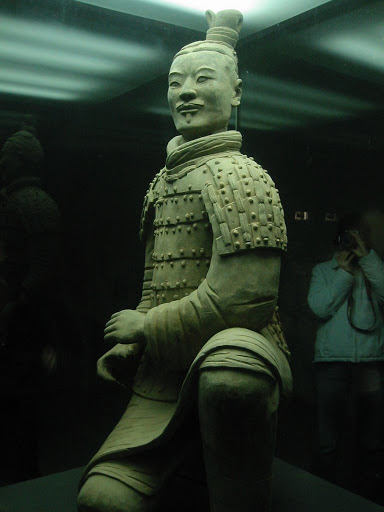
The seconds pit houses the general staff and a chariot. Most of the third and final pit is unexcavated, but a few figures have been reconstructed, including a couple of archers, a general and a lower ranking officer. These you can see up close and the level of detail is incredible, down to the tread of their shoes.

The tour gave us enough time at the warriors to see all we wanted to, then it was back to our hotels. We were tempted to request to be dropped off in the centre of Xian and explore it further, but both of us, me especially, were tired and want to call it an early night. So we found a dumpling restaurant recommended by the Lonely Planet and located across from the hotel. The difficult bit was in crossing the road, dodging the cars. Scary.

I would like to have seen more of Xian, walked the city walls and explored the Muslim Quarter. It seems a fascinating place, though sometimes the streetscapes reminded me of Beijing. Tomorrow we are off very early to Chengdu and Leshan. Time to get an early night.

Saturday, March 17, 2007

Sacrifices and cadavers

I feel like we had a little bit of a China Day today. We made it to Xi'an, but this hote, the Xi'an is not, as Ms Joe described it, at a great location. It's outside the walls and away from the bright lights and I've only had pot noodles and junk food for dinner...

This morning we checked out of our hotel in Beijing and caught a taxi to the Temple of Heaven. The temple is actually a complex of buildings located within a park. It was here that the Emporer and his retinue sacrificed animals to the gods in order to ensure a good harvest.

I wanted to sacrifice some of the singers making awful noise in the park, like shrieking birds. Chinese song cannot be defined as music. Or maybe it's just the effects of karaoke, the single worst invention in the history of mankind.

We were walking the wrong way through the complex, from north to south. So we hit the highlight first, the Hall for Prayer for Good Harvests. The empty space around this octagonal/circular building highlights its impressive architecture. It's colours are rich reds, blues, greens and gold and it sits on three levels of white marble.

The marble carvings come in three types - the dragon, the phoenix and clouds. I especially like the dragons poking horizontally outwards from the walls. One type in particular looks fat and silly rather than fearsome. He even has flat teeth.

From the park we walked around to the nearby Museum of Natural History. The animated dinosaurs and various animal skeletons are particularly interesting. Other exhibits would be more so if their English captions were better. The aquarium section smelled like a fish shop.

The most gruesome exhibits were not, as the Lonely Planet says, on the top floor, but in a separate white building near the exit gate. Here were human cadavers and organs, cut away to demonstrate different parts of the body. There was a tank containing just the male sexual and liquid waste disposal system, baby and children's faces half cut away to show the brain and teeth. I guess some would find this disgusting, but for me it was a fascinating anatomy lesson. Chinese parents seemed to have no problem with it either, as they showed their young kids around.

We walked back to our hotel, past recently demolished hutongs. Vendors were hawking hairdressing wares outside one, including bunches of human hair. We passed some local shops and bought some sweets, or so they claimed to be for we both found them awful.

After purchasing some souveniers of the Beijing 2008 Olympics from the shop beside Tiananmen Square and some more footslogging we finally reached the hotel. Our legs had given up.

Both of us slept a short while on the taxi ride to the airport, though I did catch a glimpse of the ancient observatory and crumbling remains of the city wall. I wonder if the driver pushed a button to speed up the meter, because the fare cost us more than RMB100 and seemed to tick over quickly near the end.

Beijing's airport is quite nice. There are actually decent food places after security, prior to security your best bet seems to be in the basement where a number of food vendors reside, including KFC. The pre-pay system dissuaded us from eating there, despite our hunger. Anyway, we were running out of time.

Our Hainan airlines flight morphed into a Chang'an Airlines Airbus 319, but I don't pretend to understand Chinese airline ownership. Clean aircraft, fairly comfortable and the announcements were in Chinese and sometimes unintelligible English. We even got a box of noodles or rice, a bun and pickles on the plane, though I found my inedible. I couldn't believe they continued to serve during turbulence, although considering the whole flight was rough I guess they had no choice. I couldn't wait to land.

At Xian we ignored the taxi touts and hoped on a minibus. The "conductor" did her best to explain in English that our stop was a distance away from our hotel. We passed motorways and parts of the city wall lit up like some futuristic world. Xian seems to be an interesting place and I am now regretting our short stay.

Once off the bus we made our first big taxi mistake, with a tout grabbing our bags and hustling on board, then refusing to use the meter. At the hotel RMB13 turned into RMB30 and he took our RMB20 note and drove off. Bastard, but our fault.

The hotel seems designed to absorb our money, though at least the internet access is free (I hope). The bellboy who brought our luggage (he wouldn't let us take it up ourselves) redeemed himself by being very friendly and helpful, assisting us in changing rooms when we were given a twin instead of a double (we did ask Ms Joe for doubles!).

It was late, we were away from any shops and only the western restaurant was open and changing high prices. We were "forced" to purchase pot noodles from the hotel shop. The hotel has no message to say that we are booked on tomorrow's tour of the terracotta warriors, despite us having paid for it. Finally, I can't find my ATM card - must have misplaced it.

I hope things are back to smooth tomorrow. I'm tired (too much late night blogging) and a little disappointed with the results of letting someone else book. I don't like this hotel's location and I don't like the one in Shanghai either. For both places I had better options I found myself. Already I'm wondering if we are pushing things too quickly now.

Time to relax for tomorrow's early start.

Friday, March 16, 2007

Forbidden City and the onwards journey

We now know what we are doing for the rest of our time in China. I returned to the CITS headquarters before 9am and met Ms Joe to book our onwards itinerary. Over two hours later we had thrashed out a plan.

By this time B had come looking for me. Joe had to contact the various other agencies to book our travel and told us to return at in an hour. So we checked out of our hotel and grabbed some local "pancakes" from a small vendor. When we return Joe still had more to do, so we caught a taxi to our new hotel, the Novotel Xinqiao and dumped off our bags.

We then walked a kilometre and a half to Ti'ananmen Square. It was the final day of the Communist Party's Congress and the square was closed off by soldiers and security officers. So we continued walking up through the Gate of Heavenly Peace, Mao's visage gazing down upon us.

The Forbidden City was, to be blunt, a disappointment to us. A couple of the major palaces were hidden by scaffolding and sheets as they underwent a major renovation. This removed the feeling of grand history of the location.

The audio guide, now without Roger Moore and instead looking more like a Bond gadget with location lights on a map and wireless postion sensors, was a waste of money, suppling only a little more information than the signs. At least the crowds were not too bad. In fact, we had few problems with crowds at any of the sights in and around Beijing. Perhaps March is a good time to visit! Tomorrow will give some indication of the differences between weekday and weekend crowds.

Exiting the Forbidden City from the rear, we returned to Wednesday's location opposite Jingshan Park. We took a different route back to the CITS building, walking past trendy little stores and through a hutong. We stopped off to buy some little dough and vegetable balls, hot snack food, from a small vendor.

I followed Joe out of the CITS shopfront and up into the main building. In order to make train, hotel and tour bookings the travel agents need to contact local branches of CITS, who in turn contact the hotels or buy train tickets in bulk. Thankfully the airline tickets are electronic now, but the rest of the system seems very inefficient.

I made the payment up in their offices, paying the 4% credit card surcharge, then we returned to the shopfront. Joe then required time to write up the itinerary for us and for the local agents. So we returned to the nearby restaurant where we ate the previous night, this time eating noodles and half a Peking Duck. Not as good as Quanjude, but still tasty.

Finally, by 8pm, our itinerary and tickets were finalised. Everyone else in the office was long gone. We presented Joe with a cake for her extraordinary efforts. She was so much more helpful than any other travel agent we have dealt with before. What is more, she was prepared to let us travel independently rather than pushing us on tours. We did choose a couple of local tours, but for these there was little choice anyway.

Though it did take up a big chunk of our day, I'm glad we booked the rest of the trip now. It would not have been fun to repeat the exercise continuously at each stop, not knowing if there were seats available (it did happen a number of times today).

Here goes:
  • Mar 17 - Fly Beijing to Xian
  • Mar 18 - Xian tour
  • Mar 19 - Fly Xian to Chengdu - drive to Leshan and the Big Buddha
  • Mar 20 - Chengdu, visiting the panda research centre
  • Mar 21 - Fly Chengdu to Yichang
  • Mar 22 - Hydrofoil up the Yangtze to Fengjie and return to Yichang
  • Mar 23 - Tour the dam, overnight train to Nanjing
  • Mar 24 - Explore Nanjing, overnight train to Huangshan (Yellow Mountain)
  • Mar 25 - Climb Huangshan, overnight on summit
  • Mar 26 - Overnight train to Shanghai
  • Mar 27 - Shanghai
  • Mar 28 - Shanghai, intend to visit Suzhou and canal town
  • Mar 29 - Fly Shanghai to Guilin
  • Mar 30 - River cruise to Yangshuo, fly to Shenzen
  • Mar 31 - Hong Kong
  • Apr 1 - Hong Kong to Tokyo
It's more rushed than perhaps is good, but there are rest stops built in. Anyway, it's done.

Took us an hour and a half to walk back to the Novotel Xinqiao, after getting a little lost and passing through the Oriental Plaza, a refuge for foreigners. I prefer the Novotel Peace Hotel, calmer atmosphere, but this is okay.

There has been a lot of electricity between B and I in Beijing and the sparks have been flying between us. Yep, the air is cold and very dry and there is a lot of static build up. At least the dry air means that clothes dry quickly. Over the previous two nights we have hand washed our clothes in the bath and hung them around the hotel room to dry.

I think that we will miss Beijing when we leave. It is a grand city of wide boulevardes and imposing buildings, yet narrow alleyways and tiny shops are never far away. Now to see what the rest of China has to offer!

Thursday, March 15, 2007

The Great Wall

The Great Wall of China is truly one of the world's great engineering wonders. I have read much about it recently and seen many photos. But they cannot prepare you for standing upon Chang Cheng with your own feet and seeing the wall snake across the tops of the mountains with your own eyes.

We had booked a private car to take us to Jinshanling and to pick us up from Simatai, expensive but convenient. Mr Zhao was waiting for us outisde his black "limousine" (not stretched, okay). The best word to describe him would be "oily". His balding hair was permed at the rear, hairs falling on the his white woolen jumper, he had a silver earring. However, his English was good and he was quite talkative.

The drive was at times smooth, at others downright terrifying. We took the expressway out of Beijing city, passing by Beijing's often decrepit satellite towns. According to Mr Zhao twenty years ago Beijing's government had wisely moved industry out from the city proper and out to these towns in order to improve the air quality. It showed. Rather than Beijing's mildly smoggy air, here the air was thick with smoke. I could smell it in the car.

As we passed into the hills around the Miyun Reservoir we could see big gutted fish hung from trellises beside the road, available for sale. Unlike the expressway the road was now nominally two lanes. Beijing drivers tend to go very slowly. Out here, the little blue tri-wheel trucks and overloaded vans chugged along even slower. Mr Zhao and other drivers would get impatient and we would overtake on the opposite side of the road, often into incoming traffic. We just had to trust his skills, but it wasn't easy.

Approaching the destination, we could see the wall running along the tops of the mountains. We stopped at a shop for some snacks, not having had any breakfast or even brought any food; our fault for waking too late.

Jinshanling's car park was quiet. The hotel and restaurant seemed closed, although we saw a German group walking in the opposite direction. The cable car was also shutdown.

We were alone as we took the bush path up to the Hairou Pass. The only indication that we were going the right way was the shoeprints in the mud. Soon snow drifts appeared to the sides, then on the path itself, interspersed with brown mud. The grass and small shrubs lining the path were all grey and yellow with winter.

As the path wound upwards we were joined by a young hawker. He pointed out where to walk in the snow for grip. I was glad for the grip on my new shoes but already B was doubting that she could handle the 10 kilometre walk ahead.

Our "friend" was soon joined by one of his own. Zhang Tie Jun could speak some English, the original, younger man, Zhang Guo Jun could not. Together the pointed us up the path and helped B when she started to slip in the ice.

At last we made it up to the top of the dirt path and arrived at the brick battlement marking the start of our walk along the Great Wall proper. The Jinshanling section of the wall is unrestored with very steep, broken steps and stones. I often had to climb up the steps on all fours.

After each set of steps we would wonder if we could make it all the way, but the brilliant scenery drove us onwards. The going was slow, walking and climbing punctuated by recovery breaks, but more by photo shoots. The land was brown and white, rock, dry grass and snow. Across the tall ridgetops snaked the wall, punctuated by watchtowers. After a few watchtowers the elder Zhang told us the way was now downhill.

Not quite, for we would go down, then up to the next watchtower atop the peak. And further own we could see the wall rising high into even taller mountains. But it gave us hope and made the walk easier. Certainly the walk became easier as we became more practiced.

Eventually we made it to the Simatai section. The two Zhangs said their goodbyes, asking us to purchase a book and t-shirt respectively at prices that were high. But they had helped when we needed help, took photos of the two of us (saving B from asking the rare other hiker) and had proved to be pleasant companions. What could we do but pay them? To do otherwise would have been wrong and I don't care what the Lonely Planet would say.

The Simatai section was partially restored and much easier than the Jinshanling stretch. However, when we finally reached the exit we no longer had the energy to climb the steep stretch up the other side of Simatai and high into the mountains, higher than we had been before on the wall. I think that, after no breakfast or lunch, our bodies had finally run out of energy, so we left the wall and walk the 1.3 kilometres to the carpark and exit.

The Simatai restaurant was surprisingly reasonable for a tourist trap. We just needed to eat. A young Texan, alone in the restaurant, told us that he wished that his group had taken a private car rather than a minibus tour. I gather his journey wasn't very pleasant.

We found Mr Zhao asleep in his car. Then it was back from the (smoggy) blue skies above the Wall into the smog around Beijing, the afternoon sun red above leafless lines of poplars. At one village we had to detour around an injured dog lying on the road. I wish that we could stop for him, I hope that the person walking towards him helped the friendly looking canine. It made me think of Kita, our puppy, and hope that he was safe with our in-law's dogs, a sad element to the day.

On our way back to the hotel Mr Zhao took us past the Beijing Olympic site. The main stadium, the "birdsnest", looks more interesting in design than any other stadium that I have seen, while the bubbled rectangular prism of the swimming centre is very impressive. I have a feeling that Beijing will have a very good Olympics.

We also passed by the artificial mosque towers, trees and other strange designs of the "ethnic minorities" museum. After forcing his way into oncoming traffic, Mr Zhao finally brought us back to the hotel.

We made it as far as the lobby before leaving again to the China International Travel Service headquarters across the road, to make some onward bookings. Ms Jo was extremely helpful, staying back past their 5pm closing time to assist us in looking at our options. It's a pity we didn't do this earlier, otherwise we could have caught the train to Lhasa in Tibet. Maybe we still can, if we leave enough time for someone in some other city to arrange the permit.

For now, I think that we may discard some of our plans and follow a more traditional route. So far it's fly to Chengdu, then back to Xian and onwards to Shanghai. From Shanghai we will see where else we can go. B doesn't want to catch trains, though I still do. Tomorrow morning we will go in to make our bookings. Some other westerner rudely pushed in after us and demanded assistance booking flights to other parts of Asia, despite being told that no bookings were possible. Giving foreigners a bad name.

We went looking for a supermarket to buy fruits, but I don't think that supermarkets play the same role in China as they do in Australia. We did find a whole lot of interesting local snackfoods and bakeries. Then, after giving up, there on the corner was a couple of street vendors selling pineapples, apples, pears and strawberries. Yum!

Changing hotels tomorrow, so we can spend an extra day in Beijing.

Wednesday, March 14, 2007

Marble boats and fried scorpions

We've done it! Tonight we ate scorpion and silkworm on a stick. The former was just a crispy shell and the silkworm so disgusting that it did not go down the throat but straight out into a rubbish bin. Crispy on the outside, squishy inside. Awful! In fact all of the street food that we ate along Dongfuwen Street tonight was bad.

It was an unpleasant end to an otherwise good day. In the morning we started walking towards the Forbidden City. I found the Lonely Planet China book to be too big to carry around for city use, so we purchased an LP Beijing City Guide from the Wangfujing Foreign Book store. You need to ask at the information counter where they are hidden.

Breakfast was purchased from a street vendor selling pancakes topped with egg, spring onions and chilli paste. Delicious. At one point the vendor ran out of batter in the middle of cooking a pancake and one of his customers popped into the booth and continued cooking her breakfast!

We then changed our mind and decided to go to the Summer Palace instead. This involved three different metro lines and a taxi ride. The taxis are scary, weaving across the road, narrowly missing other cars and pedestrians. Fortunately, the traffic is slow, unlike in Sydney.

Walking around the Summer Palace was a very pleasant way to spend the day. Crowds were few, allowing us to wander without constantly running into tour groups. We watched musicians and dancers perform on stage, playing bells and drums. It's a long hike up the hill to the Tower of Fragrant Buddha, past Tibetan style architecture, but visually worth it.


I wish that we had time to walk around the lake, across the many stone bridges. Instead we walked to the famous marble boat. It wasn't as impressive as its reputation would suggest. The boat does not actually float, but then neither can it sink, a good omen for China. The Lonely Planet states that the boat was built using money earmarked for modernisation of the Chinese navy, but according to the television documentary Around the World in 80 Treasures the boat already existed before the Dowager Empress Cixi's reign, but that she had had it redecorated with paddle steamer wheels to represent modernity. She sounds like a nasty piece of work, does Cixi.

Another taxi ride took us to Jingshan Park. We ate a delicious beef and vegetable noodle soup and pork and shallot dumplings for lunch in a small shop. Basic, but very tasty. Then it was on the back of a trishaw for a tour of the hutongs. The rider's grip of English was basic, but he really tried.

The hutongs were not as impressive from street level as they appeared looking down upon them from the train. However, it was a very pleasant way to spend an hour. The guide stopped us outside on hutong and an old lady showed us around for a fee of RMB20 per person. She did not speak English, but had descriptions written on cards. Expensive, but interesting and she seemed nice.
We had to go to an ATM when we realised we didn't have enough money to pay the guide. We are so unfamiliar with living in a cash society now.

Rather than catch a taxi, we decided to walk back to the hotel from our location. On the way we stopped in at Jingshan Park, climbing yet another hill to another pagoda. Wonderful view of the Forbidden City.

And so it was that we arrived back at the food stalls along Dongfuwen Street and learned that not all Beijing food is delicious.

Off to walk the Great Wall tomorrow.

Tuesday, March 13, 2007

From Hong Kong to Beijing

I am writing this on the train to Beijing. We are near Zhengzhou in Henan Province. The brown stained concrete apartment blocks are back, bare deciduous trees between the gaps, untouched yet by Spring. The sky is grey, with morning myst or coal smog I am not sure. I'm certain that, for the first time since we arrived in Asia, I saw some blue somewhere behind the cloud.

Stopped at Zhengzhou station and the lights are out, just like at Guangzhou. It is dark inside the compartment, I guess the locomotive is in the process of being exchanged, hence the lack of electricity. B is watching the Chinese portion of the “Around the World in Eighty Treasures” documentary that I copied from the television and on to a Personal Media Player. The narrator, Dan Cruikshank, visits the Forbidden City, Great Wall at Jinshanling, Summer Palace, Xian and Shanghai and eats silkworm and snake from a street vendor. All part of our plans – maybe! I hear B laugh out loud and crunch on the Korean prawn crackers we brought along as snacks.

We had spent our last morning in Hong Kong sleeping in, after a late night (very late night for me, posting to the blog). Finally packed, we left our bags at the hotel and wandered the local area in search of food, as usual taking forever to decide. She wants congee (rice porridge) or roast duck, I could stomach neither. Our explorations took us past a street devoted not to restaurants, but to supplies for restaurants; burners, cutlery, plates and more. We tried to purchase a couple of plastic mugs for the train trip, but all sales were in bulk only.

Lunch was finally eaten in a decrepit shed adorned with photos of stir fried dishes. It looked local, although the english signs were an indication that their clientel may speak languages other than Cantonese. I swear that it was B, not I, that ordered the sweet and sour pork. I went for pretzel fish (fried fish pieces in batter).

With some bananas and mandarines in hand, purchased from a street vendor, we rushed back to the hotel to collect our bags and onwards to Hung Hom train station, with a couple of MTR and KCRC train changes along the way. In a hurry, as usual leaving everything to the last moment.

Passing through Chinese immigration was surprisingly simple, no x-ray checks at all. A uniformed train attendant exchanged our paper tickets for decorative tickets. Our cabin is decked out in beech wood, brass fittings and pink and white fabrics, two low beds separated by a small table. There is a luggage storage comparment above the door, though it is mostly full of linen. The doors are lockable and there is a small brass level that, when extended down, prevents the door being opened fully. We feel a lot safer for this. The attendant can lock the door for you if both occupants need to leave at once.
There are plenty of examples of mangled English throughout the train:

“Beware of Nipping Hand”
“Needles and threats are provided for your convenience.”
“Do not panic, squeeze or jump off the train”.

The route out of Hong Kong passes by the tall tenement blocks and hills of the New Territories. Many looked much cleaner and newer than those we had passed by in Kowloon. The architecture and the tropical greenery are reminiscent of many of asian locations, Korea, Japan, even Malaysia.

Barbed wire and Chinese flags mark our transition from the Special Autonomous Region of Hong Kong into China proper. Gleaming new office skyscrapers with golden windows and pink tiled residential blocks proudly displayed the new money of Shenzen. Yet soon the cityscape disappear, to be replaced by fish farms and vegetable gardens. Small cities with buildings of dirty grey concrete and peeling paint. Everywhere demolition, with people living amongst the rubbish. The rubbish is ever present, colourful bags, bottles, plastic and everything else besides, building materials brick and concrete. Vegetables growing amongst the rubbish make you think, do I really want to eat that food?

I get an SMS from a Chinese mobile phone network, welcoming me to their country. Then another SMS from Mum announcing the birth of my niece. I SMS back a congratulations to my brother. Global roaming is great!

I see water buffalos and ancient looking sampans in canals. B is already asleep on the comfortable bed. As dusk falls we pass by a river running through mountains, hinting at beautiful scenery obscured by the dark. I wish that I knew where we were.

Dinner is a meal of stir fried beef and crab omelet in the dining car. Thankfully Hong Kong dollars are accepted for we have not had a chance to exchange them for yuan. We are seated behind a posh looking Australian couple and child. Australians everywhere the last few days, but then there are plenty of Chinese and Hong Kong citizens in Australia. It is the first time I have taken dinner in a train dining car and the food is surprisingly good.

B soon returns to sleep after the meal, but I lay back and read a book, listen to mp3's. Occasionally I peak out the window. As we pass though one city I see a very bright blue search light's beam stabbing across the sky from atop a skyscraper. Other white beams cross its path. It's a scene out of science fiction.

I sleep well during the night, only woken occasionally by a sharp bump. The cabin really is comfortable and it is good to have a decent rest.

I awake into a pale dawn landscape of bare poplars, birds nests in their branches, and cultivated fields. Frequently a village passes by, decaying red brick walls and tiled residences, looking old and very poor. On the doors and gates are red posters for the Chinese New Year. In the fields are burial markers for the ancestors of the villagers. Workers in their blue mao suits congregate or cycle out into the fields to begin the day's work.

The filth in which people live is astounding. Decay is everywhere, buildings are crumbling. And yet there is a certain beauty, a sense of age that cannot be found in Australia.

Occasionall, we see something that defies explanation. There were a series of pyramidal structure in the middle of a field. What were they? Then, after Zhengzhou was a giant sculpture of two heads at the edge of a hill. Who were they?

There is so much out there to see and so much that I don't understand. I am glad that we have caught the train rather than fly. We would have missed out on so much.

At last we arrive at Beijing West station. We pass through immigration, then exit out into a large square. Everywhere are locals, standing around, chatting, smoking, staring. Where do we go from here?

We wander along the main road in front of the station, pointed in that direction by a policeman. Taxis race past until we stick out a hand. The driver doesn't speak English, but seems to read a little. I have written down the Chinese name of the hotel, the Novotel Peace Hotel, in Pinyin and he says he knows the way.

All the buildings seem of monumental size, office blocks and genuine sights. The road is broad but still leaves little room for the constant weaving of the cars. As we approach the front of Tiananmen Square we pass a large silver dome. It's not on our maps or in the Lonely Planet. B asks the driver what it is, but he cannot make himself understood. Eventually, during a lull in the traffic, he reaches for our phrasebook and finds the English word he is looking for. “Theatre”.
The taxi ride to the hotel costs us maybe A$8. We give the friendly, helpful driver a clip-on koala, for making our trip in a nice experience.

The room in the Novotel is huge, especially in comparison to Hong Kong. The corner windows give a view towards Wangfujing Street, the television plays the National Geographic channel, but the internet is an expensive 1 RMB per minute, up to 100 RMB for the day. The hotel is super convenient for exploring central Beijing.

After a relaxing train ride we both have energy to burn, so we go in hunt of the Quanjude Duck restaurant along Wangfujing Street, past the department stores. It is easy to find, with a big neon sign. We are ushered up to the 5th floor.

The interior of the restaurant is ornately decorated in red and gold with a painted ceiling and glass chandeliers. A chef prepares the duck in front of our eyes, while a waiter demonstrates how to assemble the ingredients for the Peking Duck, duck skin and meat dipped in sauce and laid across the thin pancake, cucumber, chilli, garlic and spring onion added, then fold over the pancake. Eat. Delicious.

One whole duck provided the meal for the night and we leave very full. Not really expensive in comparison to Australia.

Afterwards we wandered the shopping strip on Wangfujing street, searching for a jacket for B. The only shop selling the jackets included an extremely pushy saleswoman. So pushy she pushes us out with her truly incessant haggling (and we know haggling). Eventually we end up in the same shop purchasing from a different woman who at least let us try some different styles. A$25 is about one tenth the price for a down jacket in Australia. B is feeling really cold and all the locals are rugged up. My fleece keeps me warm, I can't tell what the fuss was really.

On the way back to the hotel we detour along the night markets selling a wide variety of snack foods, from fried ice cream to fried scorpions. The worst is the big bowl of stewed dogs penises. I promise B that tomorrow night I will try a skewered insect, but I'm looking forward to the other dishes more.

So many things to do in Beijing. Tomorrow is the Forbidden City and whatever else we can fit in. Will three days be enough?

Sunday, March 11, 2007

Hong Kong Island

The first mission was to find breakfast. We walked south from our hotel and past the Tin Hau Temple. Inside, spiral incense burned from the ceiling. Outside, the daylight, more grey than yesterday, revealed intricately carved roof decorations atop the temple.

Further along were street stalls selling fresh produce. We ate some egg tarts, a local version of the sugar donut and a sweet and a savoury snack of peanuts wrapped in a glutinous rice flour pastry. B was still hungry, so we shared some spicy fishballs on a stick. That lead us visiting the nearest convenience stall for some flavoured milk to wash away the chili.

From Jordan MTR station we caught a train to Central on Hong Kong Island. The train was packed with Philippinos on their day off. I barely squeezed into the carriage.

At Central we decided to continue on the Sheung Wan station and follow another of the brochured walks. However, on arrival at Sheung Wan we found many of the local stores to be closed on the Sunday. We did find a dried seafood stall that sold dried turtle shells and another with skewered flying lizards for sale. Eeeew!

The weather outside was dreadful. Low visibility and drizzling. We discarded the idea of following the walk and instead caught one of the famous double decker trams. It was pleasant to cruise along and sightsee rather than walk and shop. The trams are great value and you see a lot.

Below, every spare space was crowded with Philippinos. Above were glass towers, windows reflecting the grey sky and each other. We cruised along until we reached Causeway. We couldn't find much to do there except take a peek at the wide variety of dogs for sale at the pet stores.

We walked back in the direction of Central. B was disappointed by the lack of shops or anything interesting. Along the way we purchased some hot quail eggs from the a streetside vendor who refused to be photographed. I also discovered that the same brand of my A$200+ walking shoes retailed for less that half that amount in Hong Kong.

We were hungry by the time we reached the shopping plaza at the base of the Marriot Hotel. A centre employee guided us to a department store food basement, but we were after a cooked meal. The only restaurants seemed expensive, but we couldn't be bothered to continue onwards. Besides, B had found her favourite stores, the Spanish Zara and Mango. We found ourselves unexpectedly eating French food for lunch.

The frogs leg menu was expensive for Hong Kong but good value considering the food. Yes, it did contain frogs legs (a popular dish in Hong Kong – I had eaten it before at the in-laws), a bit like chicken but not as nice. There were mains, entries and a self-serve dessert bar – yum! We were both very, very full afterwards.

After shopping, our bank balance was that much smaller and our credit cards a bit higher. More stuff to carry, but at least I now had shoes with more grip, a likely neccesity if some our travel plans came to bear.

We continued on to Admiralty station, then caught the MTR back to Mong Kok station. There we wandered the electronics and sport shoe shops. The electronic shops called to me, just like at Shinjuku in Tokyo. I want to buy, I just don't know what exactly (or more precisely, I want everything!).

Back at the Ladies Market again I bought some t-shirts, necessities as B hadn't packed enough for me. I don't think my haggling skills were quite good enough, though I got a few dollars off.

On our way back to our hotel we stopped along Nathan Road at a multi-story shopping centre dedicated to manga and Japanese anime toys. The little shops sold a wide range of fascinating miniatures. I will definitely return to checkout the Star Wars Lego for sale at one. Another had a MP4 player on display that included a NES (and other game console) emulator along with some games. As the shop keeper said “you can download more games - illegally – from the internet. I had never seen it before – cool!

At the northern boundary of the Temple Street markets we sat down for a dinner of hotpot, prawn cake and snails in black-bean sauce. I tried a snail, but it was like rubber. It's not the first time I've tried it. Molluscs just aren't my thing.

Another walk through the Temple Street markets and another late night back at the hotel. I'm looking forward to the enforced rest on the train to Beijing tomorrow, although I still feel that there is much more of Hong Kong that I would like to explore. I definitely want to spend some time here on the way back.

The Markets of Hong Kong

Unbelievable as it sounds, our flight was actually 45 minutes early into Hong Kong and we landed at around a quarter past four in the morning. The airport was mostly deserted at this hour, though the queue for the toilets was still quite long. B was feeling a bit sick, but eventually we made it out without any dramas. You know you are in Asia when the immigration officer is using a Hello Kitty pen to annotate your passport.

We weren't certain how to get to the hotel. The trains weren't yet running and nobody was around to help with buses. A kind couple visiting relatives in were going much the same direction and pointed out the bus to catch, a double decker. No change given to our proferred HK$50 note, a whole HK$4 down the drain (A$0.80, so no big deal!). It's in the Lonely Planet, as I discovered afterwards.

I had no idea where we were going for most of the trip, until we hit Nathan Road. Then I counted off the MTR (subway) stations until we hit the one closest to the hotel. The tin hau temple was a convenient reference point and we then found the hotel without difficulty. It was 6:30 am.

The hotel could not check us in for another couple of hours, so we sat in the lobby chairs and drank papaya flavoured milk for breakfast. I fell asleep, to be woken by B telling me we could go up to our room now.

Yes, our room at the Dorsett Seaview was small, but nowhere near as terribly tiny as the comments had lead us to expect. We paid more for something smaller in London and Osaka. And there were harbour glimpses!

A shower, then sleep, for we were both extremely tired.

At 11am we woke to begin our exploration of Hong Kong. At the airport we had picked up a Hong Kong walks brochure and this formed the basis for our day's sightseeing. From our hotel we walked south along Nathan Road and towards the harbour.


Nathan Road is the main drag in Kowloon. It is lined with shops selling clothes, food and electronics. Dirty high rise tenements tower over big neon signs. In detail it looks like many other asian locations, but without the ever present scooters. Where are they?

We ducked down into Jordan MTR station to purchase a couple of Octopus cards. These are stored value cards that can be used as tickets on the MTR and to purchase goods from some shops, including 7/11's.

Lunch was yum cha at the Golden Treasure, a local restaurant. There were no yum cha trollies, all had to be ordered from the menu. This was a problem as neither of us read Chinese. We just ordered what we knew by name, but it was not as good as we have eaten in Sydney.

After lunch we took a detour down Hillwood Soho and up the Knutsford Steps, trendy bar and restaurant locations, not really interesting for us. The cola and ginger flavoured gelato at Dolve Vita was good, though!

At Tsim Sha Tsui we detoured to the East Tsim Sha Tsui KCR (Kowloon Canton Railway) station where we hoped to pickup our reserved ticket to Beijing for Monday. They directed us to the main station at Hung Hom. So we used our Octopus card to catch the train. Nice train, although I'm glad I don't spend 3 hours a day on a stainless steel bench in Sydney.

Hung Hom station has a couple of shops selling Japanese sweets. In fact there are Japanese shops everywhere in Kowloon; it seems that there is a local love affair with things Japanese. I guess we can sympathise!

Purchasing the Beijing ticket was simple and one less thing to worry about. From Hung Hom we walked towards the Promenade. Our route took us through the Metropolis Plaza, with its fake flower and grass garden and the empty Hong Kong Coliseum. We passed locals fishing from bridge supports across from a container terminal.

The view across the clear green-blue water to Hong Kong Island was disappointingly obscured by heavy grey haze. Along the Avenue of Stars we kneeled down to place our hands in the handprints of the local movie celebrities and posed for photos with the statues. It's tacky, but fun. B recognised most of the names.

We rejoined Nathan Road near the famous Peninsula Hotel and caught an MTR up to Prince Edward for our next walk – the markets of Hong Kong.

Up until now my sense of direction had been perfect. Emerging from the Prince Edward MTR subway into the featureless grey haze reversed it – a problem I have in the Northern Hemisphere. I set us walking the opposite way from our intended destination, the Bird Market. Instead we walked into a building materials area, with little shops selling steel sheets, toilet bowls, wood and other hardware items.

A local set us in the right direction and we retraced our steps along Prince Edward Road West. Near empty footpaths became crowded as locals purchased flowers and plants from the many little flower market shops along the street. We stopped to eat a delicious coconut milk egg tart from a hole-in-the-wall stall. At the end of the flower market were steps up to the Yueh Po Street Bird garden.

A circular entrance lead into a peaceful garden filled with the twittering of many birds. There were small cages of finches and budgerigars, parrots chained by the ankle to their perches and tiny chicks huddling together for warmth. It was disturbing.

From the bird garden we walked back through the flower market, colourful with exotic flowers and shrubs. Above some of the shops were roof gardens, small patches of beauty amongst the stained tenement walls.

We wandered southwards until we reached the Fa Yuen Street, lined with shops selling gold and tropical fish in clear plastic bags hung from the walls, each bag containing a piece of weed. Microcosms in a bag. Tubs below held small turtles and shrimps, looking like toys. Like the birds, the method of holding the animals was inconsiderate of their comfort.
Our next market was the Ladies Market along Tung Choi Street. The goods sold were not restricted to the feminine, with stalls selling everything from pet clothes to male underwear designed to look like a puppet bird. But every few metres out would come the cry “brand copies,” enticing the pedestrian to view the collection of fake handbags.

We stopped in a small restaurant for a dinner of spicy noodles and hot pot. I really did not care for the flavours of the foods, felt like a salad rather than the heavy, salty Chinese food.

At the end of the Ladies Market was another market, an undercover wet market. Butchered animals, mostly seafood sold from stalls. Many of the fish had been partially cut open to expose their air bladders, still inflated.

Our final market was close to our hotel, the Temple Street Night Market. It had a little bit of everything and the restaurants lining the street made us regret eating earlier. The markets wrapped around the Tin Hau Temple opposite our hotel. Here were some stalls selling phallic sculptures and sex toys. There on the other side were the tents of fortune tellers. And finally were bands and singers of Chinese songs, a truly awful sound.

So we walked around the temple grounds and back to the hotel. On the way we stopped by a 7-11 and bought bottles of water and plum juice. I had never tasted plum juice before. I wish that I had read the lable because it was sour plum juice, like the Chinese “sweet”. Yuck!

An hour before midnight and we had walked from Mong Kok to the harbour. I was so tired by this stage that I was in another world and almost ran into traffic. Time for bed for the first proper, relaxed sleep in days.

Flight to Hong Kong


Friday was a panicked blur as I attempted to fit in last minute tasks before our departure overseas. In the morning we said goodbye to our 7 month old puppy, leaving him with the in-laws and their two cavalier king charles. B returned home, but I had a day at work, though I arrived late. The farewell lunch for my move to Maquarie University and Darren's to a new job was a pleasant chance to meet with my friends for the last time in a month. If not for that I would probably have been too immersed in work to talk.

The afternoon included a last minute dash to Epping to pick up a replacement ATM card that had arrived just in time for the trip. Then I packed away the last of my papers and said goodbye. As I walked down the path to Epping station for my train ride to the airport I felt like my journey had begun.

I have always felt that evenings are the best time to begin a journey. The day is over and the mystery of the night about to begin. I was glad to be leaving Sydney that night, the sticky, humid air my least favoured of climatic conditions.

Eventually B turned up, her brother driving her to the airport after a day off work. We had alredy checked in over the internet and just had to pickup our boarding passes and drop off our bags, two packpacks.

I had never flown Cathay Pacific and overall I was impressed. Unfortunately I was only able to obtain window seats near the rear of the plane, so we felt every little bump. Worse was the knowledge that the movement is always bigger at the rear and the fear of that unexpected air pocket that would drop us metres in seconds. It never came, but it was a moderately rough flight with the seat belt sign turned on a couple of times mid-flight.

At least the air was fresh the entire flight and the flight attendents very helpful. Neither of us ate the late supper. B slept, as usual, but I had at most half an hour. Instead I watched the seat-back entertainment, often unclear due to the excessive recline of the passenger in front of me. I saw South Park (lets go ninjas!), Little Britain, Office Space and Night at the Museum. The humour certainly helped to pass the time, I hope my laughter didn't disturb anyone.

Friday, March 9, 2007

Departure

Almost time to board. I hope it is a smooth flight as we are seated near the back in row 66.

FW: It's time

Only now, standing here at Epping station do I feel like my journey is beginning. The work is as close to finished as it can be, the bags are packed and my gadgets ready. I'm certain something has been forgotten, but there is nothing I can do about it. Nothing to do but relax and follow wherever this journey takes us.

Thursday, March 8, 2007

Packing, panicking


Packing and panicking, there's never enough time!